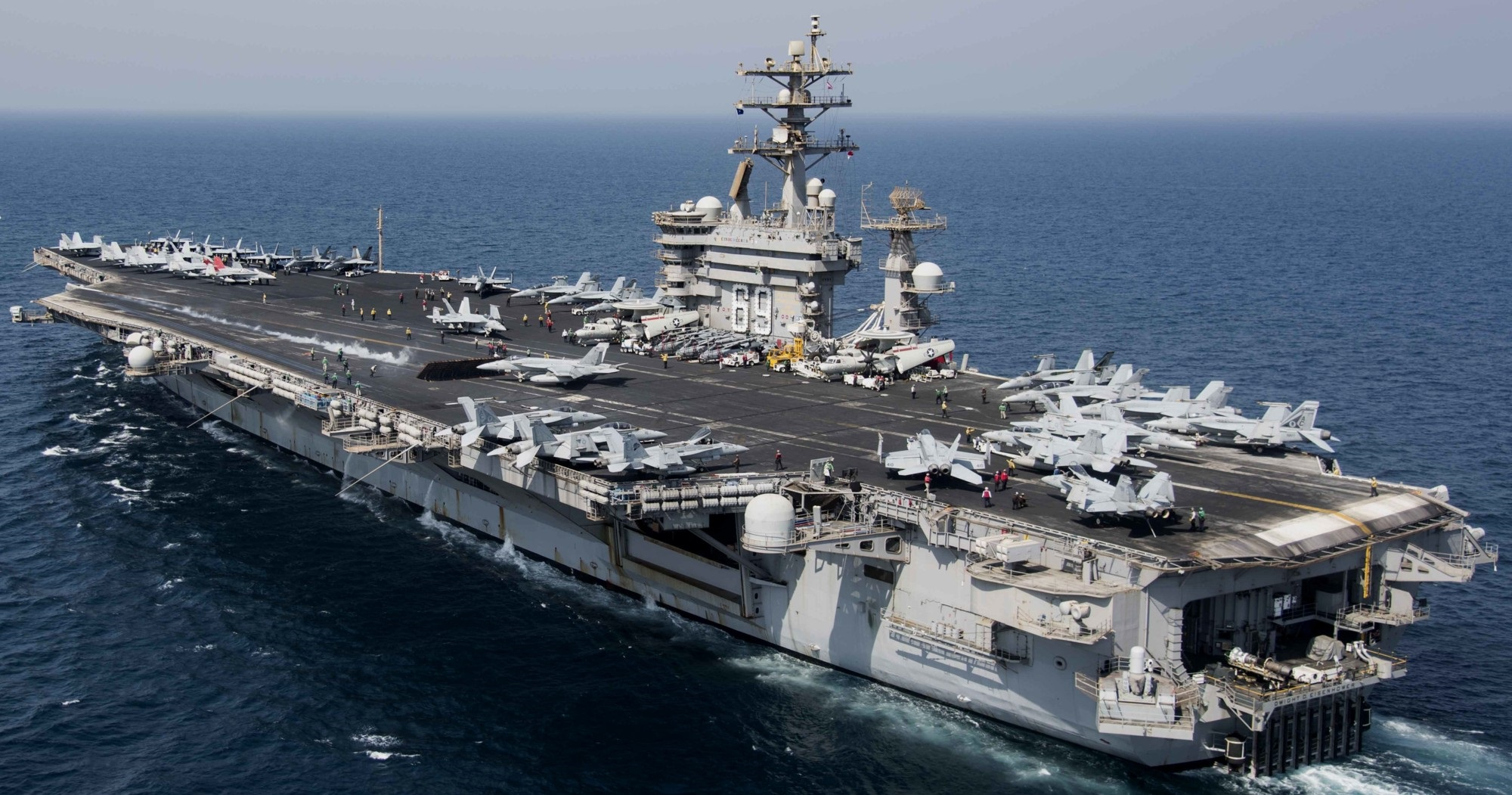




USS Dwight D. Eisenhower — CVN 69
The USS Dwight D. Eisenhower — named after the president who delivered the farewell address documented in Article I of this series — spent late 2023 through mid-2024 in the Red Sea and Gulf of Aden running Operation Prosperity Guardian. Its mission: protect commercial shipping from Iranian-backed Houthi missile and drone attacks. It conducted airstrikes on Houthi weapons facilities in Yemen. It spent more than 200 days in the 5th Fleet area of operations — one of the longest carrier deployments in recent history. It came home.(1)
It is going back. As Operation Epic Fury — the US strike campaign against Iran — enters its second week, the Eisenhower is being redeployed into the active war zone. The carrier named after the man who warned about the military-industrial complex is now the instrument of the architecture he described.
USS Dwight D. Eisenhower (CVN 69) is a Nimitz-class nuclear-powered aircraft carrier — the flagship for Commander, Carrier Strike Group 2. Commissioned 1977. Displacement: 104,600 tons full load. Length: 1,092 feet. Aircraft: 90+. From the Navy's own description: "provides a wide range of flexible mission capabilities, to include maritime security operations, expeditionary power projection, forward naval presence, crisis response, sea control, deterrence, counter-terrorism, information operations, security cooperation and counter-proliferation."(2)
"We know that our purpose is a just and moral one, for we seek only peace with freedom." — Eisenhower motto, USS CVN 69 official page
The man for whom it is named said something else on January 17, 1961. He said: guard against the acquisition of unwarranted influence by the military-industrial complex. He said the potential for the disastrous rise of misplaced power exists and will persist. He said a nation's hope of lasting peace cannot be firmly based upon any race in armaments.
The ship bearing his name is currently sailing toward a war fought with the architecture he described, against a country whose counterintelligence experts were removed from their posts before the first strike was launched.
The Strait of Hormuz — Closed
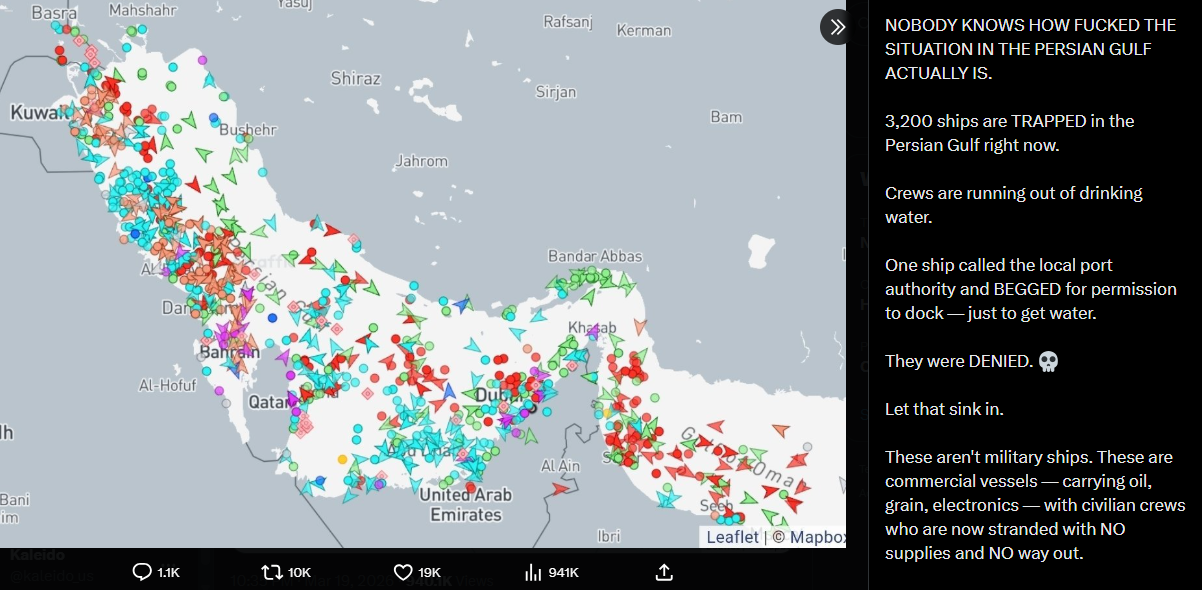
The Strait of Hormuz has been effectively closed to commercial shipping since February 28, 2026. As of March 14, the first day recorded with zero confirmed vessel transits per AIS data. More than 150 ships are stranded — tankers, bulk carriers, container vessels. War risk insurance premiums are running at over 16 times normal rates. Daily economic cost: exceeding $4 billion.(3)
Normal: ~60/day
Tankers, bulk carriers
Global estimate
25% of global LNG
vs. pre-war rates
G7 · largest ever
The G7 announced the largest-ever coordinated strategic petroleum reserve release on March 14 — 412 million barrels. Asian LNG prices are up 54%. European prices up 63% versus pre-war levels. Ships are rerouting via the Cape of Good Hope, adding up to 14 extra transit days. Tanker spot rates have tripled for Gulf-to-Asia routes. South Korea and Japan are most critically exposed. India, China, and the EU are high-impact.(3)
EU foreign ministers demanded Trump clarify when military objectives will be achieved before committing to Hormuz escort missions. Germany and Greece ruled out military involvement. Iran's foreign minister rejected resuming negotiations — stated the war must be imposed on Iran to end it. Saudi Arabia is offering an alternate Red Sea route through Yanbu. The diplomatic exits are narrowing in real time.(3)
Iran's strategy for holding the strait: swarm attacks using cheap drones and fast boats against US naval vessels. The doctrine is asymmetric by design — a $50,000 drone against a $2 billion destroyer. The goal is not to win a conventional naval battle but to raise the cost of presence to an unsustainable level and demonstrate that the strait can be made impassable on demand. The USS Eisenhower spent 2024 defending against this exact doctrine from Houthi proxies. It is now sailing toward the source.(4)
The Trump-Class Battleship
Trump announced a new class of battleships in December 2025. They will be called Trump-class. The proposed design draws on the Iowa-class reactivation of the 1980s — itself a Cold War response to Soviet Kirov-class battlecruisers. The Iowas were modernized with Tomahawks, Harpoons, and CIWS, served through the Gulf War, and were decommissioned in the 1990s when the Cold War ended and maintenance costs became untenable on WWII-era hulls.(5)
The Iowa-class lesson: even with legitimate strategic arguments for magazine depth and endurance, cost becomes the decisive factor. No official figures exist for the Trump-class. Estimates range from $10 billion to $22 billion per ship — before cost overruns, before the shipbuilding capacity problem, before the question of what threat they are designed to answer that existing carrier strike groups cannot.
Reactivated 1980s to answer Soviet Kirov threat. Cost-effective vs. new construction. Modernized with Tomahawks and CIWS. Retired 1990s — Cold War ended, maintenance costs unsustainable, WWII hulls incompatible with missile-dominated environment. The threat disappeared. The ships followed.
Announced December 2025. Named after the sitting president. No official cost figures. Estimates $10–22B per ship. US shipbuilding capacity already strained. No peer adversary requiring battleship-specific response identified. The biggest enemy, per naval analysts: cost itself.

Operation Southern Spear — The Drug Boats
Operation Southern Spear: US forces conducting maritime interdiction operations against alleged drug trafficking vessels in the Caribbean. In March 2026, the Pentagon acknowledged conducting strikes on vessels in international waters — strikes that destroyed boats and killed occupants. A Pentagon boat bombing was ruled potentially illegal by a UN human rights panel. Lawfare analysis: the strikes may constitute crimes against humanity under international humanitarian law.(6)
Carol Rosenberg — the New York Times reporter who has covered Guantanamo for 25 years and is the paper of record on US detention and military operations — reported on March 13, 2026 that a UN human rights panel has been told the Pentagon's boat bombings are illegal. The strikes are being conducted without the due process standards required by international law for use of lethal force against non-state actors. The standard being applied: suspected drug trafficking. The outcome: summary execution at sea, without trial, without verification of identity, without appeal.(7)
Fleet Movements — Today
From the Navy press office, March 16, 2026: USS Blue Ridge (LCC 19), flagship of US 7th Fleet, arrived in Manila, Philippines for a scheduled port visit — its first since 2024. USS Mustin (DDG 89), an Arleigh Burke-class guided-missile destroyer, will forward deploy permanently to Yokosuka, Japan as part of a scheduled Pacific rotation.(8)
The Pacific deployments are the long game — China deterrence, Taiwan Strait presence, South China Sea positioning. The Iran war is the current operation. Both are running simultaneously. The carrier groups, the destroyers, the logistics chains, the intelligence architecture — all operating concurrently across two theaters while the counterintelligence staff that tracks Iranian threats has been reduced by half and the national security lawyers are redacting Epstein documents.
The Algorithm — Still Running
The targeting architecture documented in Article VIII — The Algorithm Said So — is operational. The NGA director stated in September 2025 that Maven will transmit 100% machine-generated intelligence to combatant commanders by June 2026. The Lavender system in Gaza: 37,000 targets nominated. 20-second human review. 10% error rate tolerated. Zero formal appeals. The same architecture is available for the Iran campaign.(9)
The Epstein Files — Trump Assault Allegations
The DOJ Epstein file releases in January 2026 exposed the faces, names, and identifying information of nearly 100 victims — redactions described by Julie Brown as a "message to be quiet." Subsequent releases in March 2026 include documents referencing assault allegations involving Trump. The files are being released in tranches, each release managed by the Treasury Secretary who controls the financial records of the network they document.(10)
NATO — The $12 Billion Question
NATO's involvement in the Iran campaign carries a documented price tag in the range of $12 billion in allied commitments and support structures — a figure that encompasses logistics, intelligence sharing, and forward basing access. The alliance's Article 5 collective defense commitment was not invoked for the Iran strikes. The operation is a US unilateral action with allied support — a distinction that matters significantly for international law, burden-sharing, and the precedent being set for future operations.(11)
The Cirincione Warning
Joe Cirincione — nuclear policy expert, former Ploughshares Fund president — has been among the loudest voices warning about nuclear escalation risk in the Iran conflict. The concern: Iran's nuclear program, if sufficiently threatened, creates pressure to accelerate weaponization rather than abandon it. The logic of deterrence runs in both directions. A country watching its conventional military be degraded by a technologically superior adversary has increasing incentive to acquire the one weapon that makes conventional superiority irrelevant.(12)
"A nation's hope of lasting peace cannot be firmly based upon any race in armaments but rather upon just relations and honest understanding with all other nations." — Dwight D. Eisenhower, The Chance for Peace, April 16, 1953. Seventy-three years ago. The man on the ship's nameplate said this. The ship is underway.
What Real Time Means
This article will be updated as events develop. The series documented the architecture. This page watches it run. The entries above are dated. The receipts are sourced. The machine is not theoretical. It is operational, today, March 16, 2026 — running across the Persian Gulf, the Caribbean Sea, the Strait of Hormuz, the targeting servers in Ramstein, the Treasury Department offices where the Epstein files are being managed by the man whose job is to prevent their full release.
Eisenhower warned us. They took notes. The ship is at sea.
The people documented in this series — Ellsberg, Serpico, Manning, Snowden, Klein, Winner, Hale, Vindman, the six prosecutors, the 200+ Armageddon complainants — are the counter-architecture. The machine runs on the assumption that the record won't be kept. We are keeping the record.
← Return to Series Overview: Wartime Treasure — A Criminal's Delight