I. The Pivot
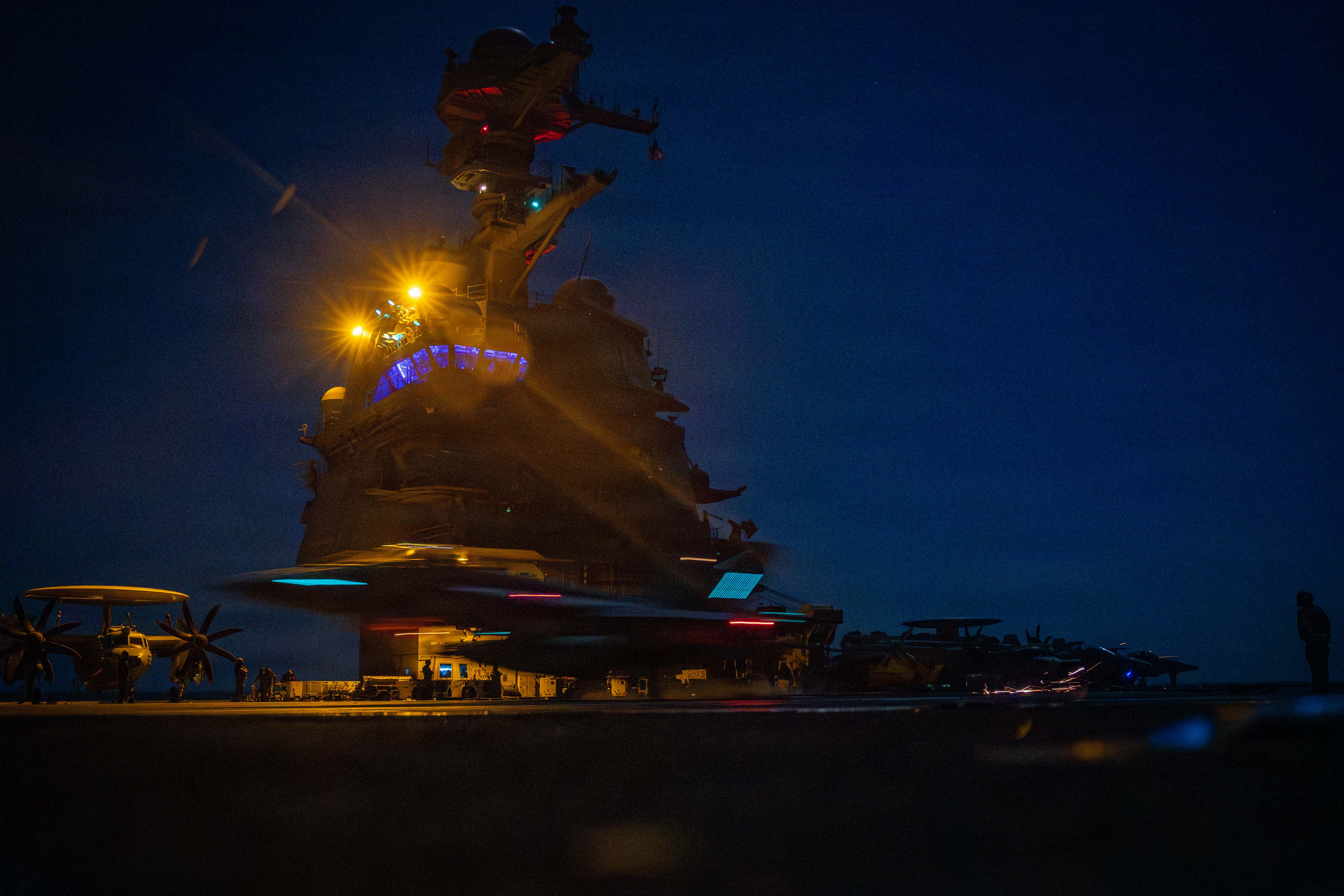
On March 12, 2026, a fire broke out in the laundry spaces of the USS Gerald R. Ford — the world's largest warship, eleven months into Operation Epic Fury, the ongoing US-Israeli war on Iran. The blaze spread through ventilation systems into berthing areas, destroying beds and personal effects for over 600 sailors. Investigators began examining whether the fire had been set deliberately — exhaustion so severe that sailors may have torched their own ship to force a port call.1
The Ford turned toward Crete.
There was nowhere else to go. Souda Bay on the island of Crete is the only deep-water port in the entire Mediterranean — all of Southern Europe, all of North Africa, the entire sea — capable of receiving a supercarrier. The only comparable facilities in the world sit in San Diego, Norfolk, and Puget Sound.2 When the largest warship in human history needs emergency repairs while fighting a war in the Middle East, one country receives it. One harbor holds it. One small NATO ally becomes, without fanfare or formal declaration, the linchpin of American military power projection across three continents.
That country is Greece. And Greece has been building toward this moment for fifteen years.
"It is not a television war. It has victims. It causes great damage. It disrupts people's daily lives. It creates anxiety and fear. It is nearby."
— Antonis Diamataris, National Herald, from Athens, March 3, 2026
II. Three Greeces
To understand Greece's current position, stop thinking of it as a single actor and start thinking of it as three simultaneous ones — each operating with its own logic, its own risk tolerance, and its own relationship to the war it officially doesn't belong to.
Political Greece
At the United Nations in September 2025, Prime Minister Kyriakos Mitsotakis addressed Israel directly: "There is a risk of losing allies if the two-state solution is not accepted. Nothing justifies the killing of thousands of children and the immense humanitarian suffering of Palestinians."3 He had said the same to Netanyahu's face months earlier: "I have personally told Prime Minister Netanyahu that the brutal October 7 attack does not justify military operations that inflict disproportionate humanitarian suffering."4
Then, in December 2025, Greece co-signed a joint declaration with Israel that "rejected the unfounded allegations against Israel," affirmed Israel's right to self-defense, and formalized a new trilateral rapid-response military force in the eastern Mediterranean.5
This is not hypocrisy. It is the architecture of maximum leverage. Political Greece says what Europe needs to hear. Then it signs what Israel needs to sign. Then it hosts what America needs to harbor. The three tracks never collide because they are never meant to.
Military Greece
The military picture is starker. Arleigh Burke-class destroyers stationed at Souda Bay directly participated in intercepting Iranian missiles fired at Israeli territory.6 Seven KC-135 refueling tankers for Iran strike missions staged at Souda Bay in February 2026 — part of what analysts described as an "air bridge" supporting operations against Iranian nuclear sites.7 Greek F-16s have been reported forward-positioned in Cyprus.8
Israel and Greece's defense industries are merging in real time. Israel Aerospace Industries acquired Greek defense company Intracom Defense for approximately €60 million. Rafael supplied Greece with SPIKE missiles in a deal worth roughly €370 million. Athens was in negotiations for a €2 billion anti-aircraft system modeled on Iron Dome.9 The March 2025 Mitsotakis visit to Israel included a strategic session with executives from IAI, Rafael, and Elbit Systems — all three actively operating in Greece.10
The US-Greece mutual defense agreement, updated in 2021, made a careful linguistic choice: the document uses the word "facilitator" rather than "base." Greece is not a base. Greece facilitates. The USS Ford is not based there. It is being facilitated.11
Commercial Greece
The people calculating personal benefit from these decisions number in the thousands globally, not millions. They sit at the intersection of defense contracting, energy markets, and political access. The Greek shipping oligarchs running Hormuz at $440,000 a day are a perfect microcosm — and Greece controls the largest commercial shipping fleet in the world by tonnage.
While the government issued advisories urging shipowners to avoid the Strait of Hormuz, billionaire George Prokopiou's Dynacom Tankers Management sent at least five tankers through the strait in early March — armed guards on deck, AIS transponders switched off. Four times the pre-war rate. The Embiricos family's Aeolos Management also ran the strait.12
As of March 17, 2026, the Greek Deputy Minister of Shipping confirmed 34 Greek-flagged vessels operating across the Red Sea, Arabian Sea, Gulf of Oman, and Persian Gulf — ten inside the Persian Gulf itself.13 A Greek-owned bulk carrier was among vessels struck by Iranian attacks. Greek ships have been hit. Greek ships are still sailing.
This is not new. When the Suez Crisis sent tanker rates soaring in the 1950s, Aristotle Onassis and Stavros Niarchos made fortunes while other nations argued about international law. The instinct is structural. Greek maritime culture has always treated geopolitical catastrophe as a market condition.14
"We fall, they fall. We save ourselves, we save the world."
— The operating logic of every war-era oligarch, from Onassis to Prokopiou
Souda Bay: The Only Port That Matters
- Only deep-water supercarrier port in the entire Mediterranean and Southern Europe
- $5.2M new US logistics warehouse opened at Souda Bay, April 2025
- USS Harry S. Truman — repaired at Souda after Suez Canal collision, Feb 2025; returned to Houthi strike ops
- USS Gerald R. Ford — repaired at Souda, March 2026, after 11-month Iran war deployment and suspected arson fire
- 7 KC-135 refueling tankers staged at Souda for Iran strike operations, Feb 2026
- Patriot PAC-3 batteries now on Crete; additional battery rushed to Karpathos island
- Active espionage arrests near the base — foreign nationals surveilling naval traffic, including a Polish national living in a caravan overlooking the harbor
III. The Fugitive's Harbor
On June 13, 2025, hours after Israel launched strikes deep into Iranian territory, Benjamin Netanyahu's official jet — the "Wing of Zion" — landed at Athens airport. The ICC had issued an arrest warrant for Netanyahu in November 2024. As a party to the Rome Statute, Greece is formally obligated to arrest him on entry.15
The Greek government had already telegraphed its answer. The government spokesman "refrained from confirming whether the warrant would be enforced," drawing a distinction between Israel and countries that "initiated hostilities" — making clear Athens would not act on the warrant.16 Greece had become one of the only EU member states where Netanyahu's jet could reliably land without incident.
By December 2025, Netanyahu was hosting the Greek PM and Cypriot President in Jerusalem for their tenth trilateral summit. By March 2026, Mitsotakis was back in Jerusalem for defense industry meetings. The relationship has survived Gaza, the ICC warrant, the Iran war, and thousands of protesters in Athens calling it complicity in genocide. A 2024 survey found a majority of Greek parliamentarians favored deepening cooperation between Israel and NATO.17 The political class has chosen this, deliberately.
IV. The Iranian Equation
Iran named Souda Bay explicitly. In early 2026, the IRGC designated all US bases and interests in the region as legitimate targets, with Iranian statements specifically referencing the Cretan facility.18 On March 1, 2026, a drone struck the British base at RAF Akrotiri in Cyprus — 500 miles from Crete. The threat is not theoretical. It is kinetic. It has already landed on a NATO island.
Greece's Defense Minister Nikos Dendias chose his words with surgical precision: Crete lies "at the limits of the maximum range" of Iranian weapons. He announced a Patriot battery would be rushed to Karpathos island to plug the gap.19 "At the limits" is not reassurance. It is an admission.
A Greek survey found 77% of citizens reported fear across all political affiliations.20 Thousands marched to the US Embassy in Athens demanding base closures. One protester: "We consider the stance of the Greek government to be despicable, because it not only puts us in danger by hosting American bases all over the country, but also has very strong ties with the state of Israel that is conducting a genocide with the United States. We see them making moves, either with the frigates in the Red Sea or the F-16s in Cyprus. That shows our country wants to be part of the war."21
The government's position — Greece as facilitator, not participant — is legally careful and operationally hollow. Greek-based destroyers intercepted Iranian missiles. Greek-harbored carriers launched strikes. Greek-approved tankers refueled the strike groups. At what point does facilitation become belligerence? International law has an answer. It is an uncomfortable one for Athens.
"Among us, as you know, there are top Greek shipowners who are very worried. But unless there is a mission approved by Europe, Greece will not participate on its own."
— PM Mitsotakis, March 17, 2026 — as Greek-flagged vessels ran Hormuz without government approval or escort
V. The China Layer
The Strait of Hormuz is now a permission system. Iran controls who passes. The architecture of that system tells you everything about the geopolitics of 2026.
Since Operation Epic Fury began February 28, at least 11.7 million barrels of Iranian crude have transited Hormuz — all of it headed to China. Iranian tankers run dark, disabling AIS transponders, resurfacing days later in Malaysian waters for ship-to-ship transfers that launder the oil's origin before it reaches Chinese ports.22 The ghost fleet has not stopped. It has accelerated.
China imports 40% of its oil through Hormuz and receives 30% of its LNG supply through the same chokepoint.23 Beijing publicly calls for peace and an open strait. Privately, China is in negotiations with Iran to secure safe passage — a deal that could include port access or basing rights near Hormuz. The shape of those concessions is the most consequential intelligence question in the region right now.
The new Supreme Leader, Mojtaba Khamenei — named to power after his father was killed in the US-Israeli strikes — stated in his first public address: "The lever of blocking the Strait of Hormuz must definitely be used."24 China's desperation for passage gives him enormous room to extract concessions before he releases it. Oil is above $100 per barrel. The war is not just a military event. It is an energy redistribution system. And the distribution is being decided by Iran, one negotiated corridor at a time.
Hormuz: The Permission System
- Iran-flagged: Free passage to China — 11.7M barrels since Feb 28
- China-linked vessels: Largely avoided by Iran — 11 transits Mar 1–15 per Lloyd's List
- India: Two LPG carriers cleared after direct diplomatic intervention
- Pakistan: One crude tanker cleared March 16
- Turkey: One vessel cleared after IRGC approval
- Greece-affiliated: Confirmed crossings — dark transponders, armed guards, $440k/day
- US, Israel, Western allies: No passage. Any vessel attempting transit risks attack
- Total traffic: Down from 100–135 ships/day to ~13/day since Feb 28
VI. The Canada Mirror
To understand what Greece has chosen, look at a country that did not choose it.
Canada was not consulted before Operation Epic Fury. It was not warned. It was not asked. Canadian Foreign Minister Anita Anand said it plainly from Ankara: "Canada was not consulted, did not participate in the military action, and has no intention of participating in the offensive military operation."25 Prime Minister Carney called the war "a failure of the international order."
And yet. Retired Major-General Denis Thompson noted that Canadian officers embedded in US war-fighting headquarters at the Combined Aerospace Operations Centre would have been "directly involved in targeting."26 Canadian ships are stuck in the Persian Gulf. Canadian citizens are stranded. The government's position shifted from outrage to ambiguity to official non-participation within two weeks. Former foreign minister Lloyd Axworthy called the response "very confusing."
Canada is experiencing the bewilderment of a country that thought the alliance had rules, procedures, consultations. It is discovering mid-war that the alliance has none of those things when the United States decides to move.
Greece never had that confusion. Greece spent fifteen years making itself impossible to exclude. It never asked to be consulted. It simply became the port the carriers needed, the runway the tankers refueled from, the diplomatic safe house the ICC fugitive could land at. When the war came, Greece was already inside it — by design, by incremental choice, by the patient accumulation of indispensability.
Canada is asking: how did we get here? Greece never asked that question. Greece built "here" deliberately, one defense agreement and one carrier repair at a time.
VII. The Bill Comes Due
Greece now sits on the UN Security Council for 2025–2026. Mitsotakis stood at that podium and said "Dialogue, Diplomacy, and Democracy" would guide his tenure — in a chamber where Greece has been simultaneously calling for Gaza ceasefire while co-developing Iron Dome with the country conducting the siege, hosting US carrier strike groups while voting on resolutions about their operations.27
The espionage arrests near Souda Bay have accelerated. A Polish national was arrested in a caravan directly overlooking the base, positioned to monitor naval traffic. Greek intelligence has the base under heightened surveillance. Someone is counting what docks there. Someone is transmitting what they see.28
Iran has not struck Souda Bay. Not yet. Whether this reflects the limits of Iranian capability, a strategic calculation that striking a NATO member triggers Article 5, or a tactical decision to hold the threat in reserve as leverage — none of this can be determined from open sources. What can be determined: the question is no longer theoretical. The drone that hit Akrotiri was not a warning shot. It was a capability demonstration.
Mitsotakis told a radio interviewer that Iran striking Souda "has no basis." He would not comment on military consultations. He was simultaneously moving Patriots to Karpathos.29 Both statements are true. That is, precisely, the problem.
"There is a difference between taking what you want and making someone give it to you."
— Thomas Schelling, Arms and Influence, 1966 — the foundational text on compellence theory, written before Greece joined NATO's southern flank
The arrests near Souda Bay are espionage in the narrow sense — foreign nationals surveilling a military installation. But the broader condition Greece finds itself in has a more precise name in international relations theory: compellence. Not the coercion of an adversary. The coercion of an ally — the systematic use of inducements, dependencies, and implicit threats to ensure that a smaller state's sovereign choices align with a larger power's strategic requirements. The defense contracts, the Iron Dome negotiations, the carrier repairs, the ICC shelter — each one was a carrot. The implicit stick was never stated: refuse, and you lose US protection against Turkey, against Iran, against anyone who wants to test your borders. Greece didn't choose this arrangement from a position of freedom. It chose it from a position of calculated vulnerability — and then accelerated it, until the line between facilitation and participation collapsed to something that cannot be measured from a harbor in Crete, or from a caravan overlooking it.
77% of Greeks are afraid. The shipowners are making fortunes. The defense ministers are counting missile batteries. The Prime Minister is flying to Jerusalem. The USS Ford is in the harbor having its laundry spaces rebuilt.
Greece is not untouchable. Greece is indispensable. Those are very different things. Indispensable means everyone needs you. It also means everyone has a reason to threaten you, to surveil you, to test your defenses, to calculate exactly how much damage they can do before the NATO response makes the cost too high.
The decisions that produced this moment — Gaza, the Iran strikes, the Hormuz closure, the Ford in Souda Bay — were made by a remarkably small number of people operating from positions of extraordinary financial insulation. At least 73 of the 100 sitting US senators have a median net worth exceeding one million dollars, according to a NOTUS analysis of financial disclosures.30 Greek shipowners running tankers through an active war zone at $440,000 a day are not making foreign policy — they are responding to incentives that foreign policy created for them. The architecture of who benefits and who absorbs the risk is not incidental to these decisions. It is the decisions. When 77% of Greek citizens are afraid and one shipping family is having the most profitable week of the decade, the distribution of consequences is functioning exactly as designed.
The Patriot battery heading to Karpathos is not a symbol of strength. It is an admission that the gamble has a price. And somewhere on Crete, watching the Ford's deck lights from a hillside above Souda Bay, someone — a worried citizen, a foreign intelligence officer, an exhausted sailor, a shipowner counting freight rates — knows that the bill is not yet paid.