I. The Node
The Metropolitan Detention Center in Brooklyn has housed, at various points in recent months, simultaneously: Sean Combs — convicted on charges including sex trafficking and racketeering; Sam Bankman-Fried — who collapsed a $32 billion cryptocurrency exchange; Juan Orlando Hernández — former President of Honduras, convicted of narco-trafficking; Nicolás Maduro's associates — placed there by the Trump administration; and Guo Wengui — convicted of nine federal counts including racketeering conspiracy, securities fraud and money laundering, whose sentencing remains permanently adjourned.(28)
This is not a prison. This is a node.
Each of these men — by radically different paths through radically different industries, in radically different decades and countries — accumulated the same three things: compromising material on powerful people, networks that crossed between legitimate and criminal infrastructure, and relationships with law enforcement and state power that ran in both directions. The clandestine operation did not stop when the cell door closed. It found a new address.
II. The Classification System
The apparatus that produced the 1922 Ukraine intelligence report, that built the Metropolitan Detention Center's current guest list, that manages which files get released and which stay locked — runs on a single binary. Asset or problem. Every person, every culture, every nation, every movement that accumulates independent power gets processed through that classification. The output determines everything that follows: access or suppression, protection or destruction, the sentencing that proceeds or the one that stays permanently adjourned.
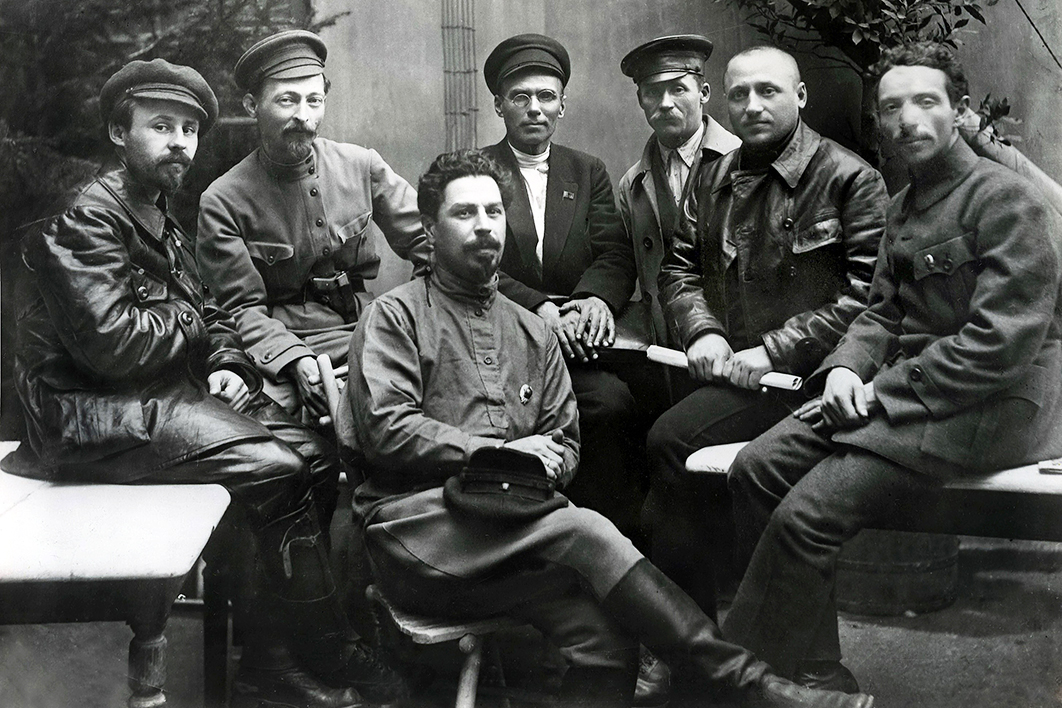
The system is not new. The Cheka — the All-Russian Extraordinary Commission, first modern secret police apparatus, founded December 1917 — ran the same classification. Its operatives are in the header photograph of this article. Seven men in leather jackets. The apparatus they built became the GPU, then the NKVD, then the KGB, then the FSB. Vladimir Putin has been referred to in Russian media as a "chekist" throughout his career. The name changes. The leather jackets stay. The classification logic stays.
In 1968, the Soviet Union broadcast a television series called The Sword and the Shield. A brave Russian spy goes under deep cover to infiltrate the Nazis. The message was earnest: people owed a debt to the soldiers fighting on the invisible front, who tirelessly worked to keep the motherland safe. The series was a sensation. Everyone watched it.
Including a boy in Leningrad who had wanted to be an airline pilot.
He would later describe what the series did to him: "What amazed me most of all was how one man's effort could achieve what whole armies could not." He was sixteen. He walked to the KGB's Leningrad headquarters — the Big House — and told the officer at reception that he wanted to join. He was turned away. Too young. Come back after military service or higher education. He went away and made himself worthy of it.
He joined the KGB. He served in East Germany. He watched the Soviet Union collapse. He rose through the FSB — the Cheka's latest name. In 1999, at the Lubyanka as FSB director, he told his colleagues: "There is no such thing as a former Chekist." Weeks later Boris Yeltsin appointed him Prime Minister. Months later, President.
More than forty years after the broadcast, Vladimir Putin still sang the theme song from The Sword and the Shield as a party piece. The song began: Where does the Motherland begin? The answer — he still knew by heart — was: from the oath you swear to her in your youthful heart.
In 1991 the statue of Feliks Dzerzhinsky outside the Lubyanka was torn down by crowds celebrating the end of the Soviet era. In 2023 a new statue was erected outside Russia's foreign intelligence headquarters. The face in the header of this article built the thing that built the man who rebuilt the statue of that face.
That is not inheritance. That is the oath in the youthful heart, kept for fifty years.(31)
The chaos of the 1990s had generated a growing nostalgia for the past. Putin was a man who appeared to offer an end to the dark days of humiliation. He would restore order. He had risen partly because he appeared to be a blank slate — someone the powerful thought they could manipulate, someone who would protect their wealth and power. But he had cleverly played on his image as a Chekist. Who better to protect the motherland and restore the power of the state than a selfless follower of Saint Feliks?
The modern Chekist was framed as part of an elite — medieval knights who served the ruler but also protected the people, kept order, acted without self-interest. An echo of the founding myths around Dzerzhinsky himself. There was talk of something called spiritual security. The need to protect Russia's soul from dark forces. Putin's ambition was to restore Russia to its glory, to put a stop to its disintegration.
American presidents said they had looked into his eyes and seen his soul. British prime ministers said he was a man they could do business with. They were all proved wrong. Only a few could understand what his rise really signified.(31)
Gordon Corera — Putin, the Once and Future Chekist · Engelsberg Ideas →
Its Culture was freedom & joy. The specific kind of freedom that crosses every line the classification system draws — but now makes the lines visible so only the powerful can cross them.
Which is why the primary terrain of the clandestine war is not always a battlefield. Sometimes it's a belief or an opinion, sometimes it is a beachside resort in Palm Beach where classified documents were stored in a bathroom and a ballroom... while another ballrooms is under construction and inside the house it's now full of cheap gaudy gold accents. Where the judge assigned to the case — Aileen Cannon, a Trump appointee — dismissed the indictment before it reached trial. Where ten FBI agents who worked the investigation were subsequently fired. The classification system does not only classify people. It classifies what gets prosecuted and what gets dismissed. Who gets appointed and who gets removed. Which building gets searched and which files stay locked.(30c)
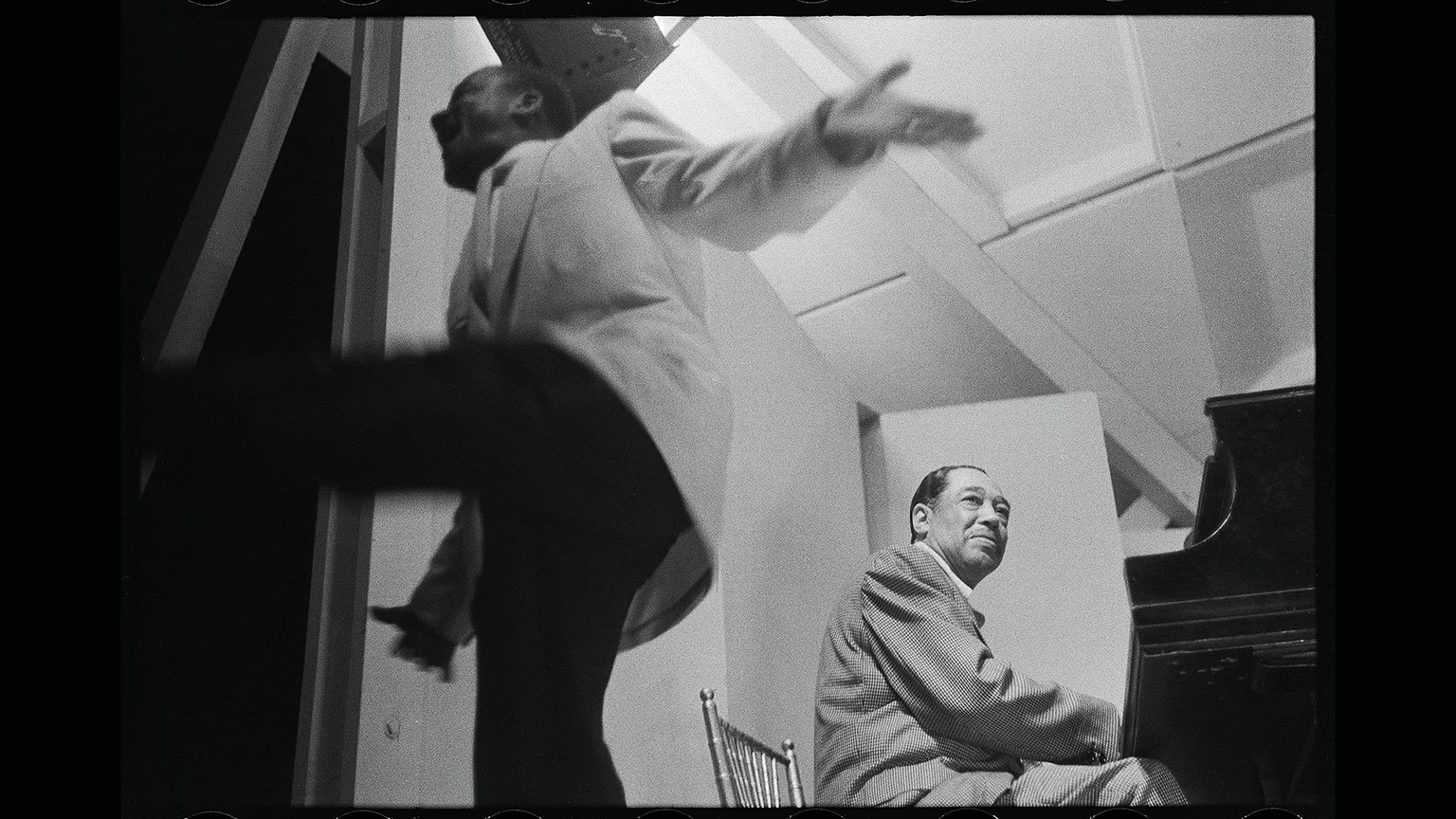
The FBI's surveillance of the jazz world — the 1956 Lisette Model photographs buried for 66 years, the 28-page informant file on a Jewish refugee photographer, the destruction of files on Sam Cooke, Nina Simone and Richie Havens — is documented in Article VII. This article extends that thread into the full clandestine architecture underneath it, and forward to the cell in Brooklyn.
III. Asset or Problem
The FBI's Counter Intelligence Program — COINTELPRO — ran officially from the 1950s until the early 1970s. Its stated mandate was to "expose, disrupt, misdirect, discredit, or otherwise neutralize" subversive political groups. In practice, it spent the majority of its energy targeting Black civil rights organizations and the Black musicians whose cultural influence made them adjacent to political power.(1)
The classification logic was not primarily ideological. It was operational. Black cultural production was generating wealth, solidarity, and influence outside institutional control. That made it a threat — not because the artists were radicals, but because the infrastructure they represented was independent. The racism was the operating system the classification ran on. But the output was always the same binary: asset or problem.
Asset
Useful. Deployable. Generates revenue, cultural influence, or political leverage for the operators of the system — the label, the agency, the state. Access to the best venues, the biggest audiences, the most lucrative contracts. Protected, as long as the protection serves someone above you in the chain.
Problem
Too independent. Too politically vocal. Building infrastructure outside the system's control. Refusing direction. Integrating spaces that were not meant to be integrated. Singing songs that were not meant to be sung. The same mechanisms used to make an asset useful are redirected: the venue access withdrawn, the cabaret license revoked, the drug supply managed, the informant activated, the file opened.
Cole was not known for radical politics. He had performed at the Republican National Convention in support of President Eisenhower. It did not matter. FBI agent Mark Felt — later identified as the Watergate informant "Deep Throat" — wrote to J. Edgar Hoover in 1957 that a trusted informant had identified Cole as his "most pressing problem at the moment." The reason: two Las Vegas hotels were breaking with the tradition of a segregated Strip and allowing Black guests during Cole's run at the Sands Hotel. Felt reported to Hoover that Vegas would be monitored for the remainder of Cole's presence.(2)
Cole was not surveilled for what he believed. He was surveilled for what happened in rooms where he performed.
Duke Ellington earned an FBI file in 1938 for endorsing the All-Harlem Youth Conference — a progressive conference focused on unemployment that Eleanor Roosevelt had also expressed support for. The FBI labeled it a Communist front. Ellington was monitored for nearly four decades, despite multiple public denunciations of communism including an article titled "No Red Songs for Me." The file ran because he existed at the intersection of Black cultural power and integrated audiences. That intersection was the threat.(3)
Max Roach received a late-night visit from two FBI agents at his home in 1965. They interrogated him about Black nationalist groups he had no connection to. Charles Mingus was tracked for attending an anti-Vietnam War event. Gil Scott-Heron's FOIA file classified his speaking at a socialist gathering as an "extremist matter."(4)
Harry Anslinger — head of the Federal Bureau of Narcotics — maintained a file called "Marijuana and Musicians" packed with surveillance details on the era's most prominent Black artists. Files on Sam Cooke, Nina Simone, and Richie Havens were later destroyed. Deliberate erasure is itself part of the record.(5)
III. Strange Fruit
In 1939, Billie Holiday performed at Café Society in Manhattan — the city's first racially integrated nightclub. She rode the service elevator because she was not permitted to use the front door. Onstage, she sang "Strange Fruit" — an anti-lynching song about Black bodies hanging from Southern trees, written by Abel Meeropol after seeing a photograph of a 1930 lynching in Indiana. Holiday had strict performance rules for the song: waiters could not take orders, lights were switched off, silence had to follow immediately. It was always the last song she performed. She controlled the room completely at the moment of maximum emotional exposure for the audience.
That night, she received a warning from Harry Anslinger's Federal Bureau of Narcotics: stop singing the song.(6)
She did not stop.
The United States of America v. Billie Holiday
What followed was not incidental. It was a documented, systematic, two-decade federal operation against a single singer. The documented record — court filings, agent testimony, declassified files — shows: at least three raids, two undercover agents, planted drug evidence, multiple arrests, associates who became paid informants, blocked access to lawyers and medical care, a federal prison sentence, the permanent revocation of her cabaret performer's license, and two separate court cases.(7)
Anslinger assigned Jimmy Fletcher — a Black agent, chosen specifically because Holiday was based in Harlem and Anslinger needed someone who could operate without suspicion — to surveil her. Fletcher spent two years in her world. He later spent the rest of his life ashamed of what he did. "You victimize yourself by becoming a junkie," he had told himself as justification. He fell in love with her. He turned her in anyway. The asset classification ran through personal relationships as naturally as it ran through institutions.(8)
The cabaret license revocation was the most precise mechanism. To perform anywhere that served alcohol in New York — which meant virtually every venue a jazz singer could headline — required a cabaret performer's license issued by the city. After her 1947 federal prison sentence, Anslinger ensured she did not get it back. He took singing from Billie Holiday. She naturally relapsed. The mechanism fed itself.(9)
A note on the historical record: there is documented scholarly dispute about whether Anslinger targeted Holiday specifically because of "Strange Fruit" or primarily because of her drug use as a high-profile enforcement target. Jazz historian Lewis Porter has stated there was no documented federal objection to the song itself. We note this dispute and present what is not disputed: the documented apparatus used against her, regardless of its stated rationale, was a twenty-year federal destruction of a singer who refused to comply. The mechanism is the receipt. The motive dispute does not change the mechanism.(10)
By June 1959, Holiday was in New York's Metropolitan Hospital, dying from liver and heart disease. She was given methadone and began to recover. Anslinger ordered agents from the Federal Bureau of Narcotics to enter her hospital room and arrest her for drug possession. They handcuffed her to the bed. A judge later ordered the cuffs removed. On Anslinger's orders, the methadone was cut off. Visitors were denied. She was fingerprinted and photographed in the hospital bed, interrogated without a lawyer present. Outside the hospital, fans held signs: "Let Lady Day Live."(11)
Billie Holiday died in that locked hospital room on July 17, 1959. She was 44.
Harry Anslinger died in 1975. He was 83. At the end of his life, he took morphine for the pain.
The racial double standard in Anslinger's approach is documented and uncontested. Judy Garland's well-known dependence on amphetamines and barbiturates was handled by Anslinger with quiet suggestion — a personal visit to the heads of MGM to recommend rehabilitation. Garland never faced arrest. Never lost her license to perform. Never had evidence planted in her hotel rooms. Her addiction was a medical matter. Holiday's was a federal case. The difference between them was not the addiction. It was the song, and the skin, and the room she commanded when the lights went down.(12)
IV. The Paradox
While the FBI was surveilling jazz musicians as domestic threats — opening files, planting informants, revoking licenses, monitoring integrated hotel rooms — the CIA was simultaneously deploying the same music as foreign propaganda.(13)
In 1950, the CIA covertly created the Congress for Cultural Freedom — widely described by the agency itself as one of its "more daring and effective Cold War covert operations." At its peak it had offices in thirty-five countries, published over twenty prestige magazines, held international art exhibitions, organized music festivals, and dispatched American performers abroad as instruments of soft power. The mandate: demonstrate that American culture — free, individualist, expressive — was proof that liberal democracy was superior to Soviet communism.(14)
The instrument chosen for this proof was jazz. The performers chosen were Black. The CIA sent jazz musicians and symphony orchestras abroad with intelligence officers discreetly embedded in their touring parties as "staff."(15) Louis Armstrong — who had an FBI file, who had been surveilled at home, whose performance venues were monitored for the crime of integrating them — was dispatched as a jazz ambassador to Africa and the developing world to demonstrate American racial harmony to foreign audiences.
Armstrong initially refused to participate in State Department-sponsored tours. He was publicly critical of the federal government's failure to protect Black students during the Little Rock crisis in 1957, saying President Eisenhower had "no guts" and that the government could "go to hell." He was persuaded to participate in tours only after some legal progress on civil rights. The man the FBI was watching at home — the man who would not use the front entrance — was the face America chose to show the world.(16)
The paradox was not contradiction. It was operational precision. The same Black cultural production that was dangerous inside America — because it generated independent power, integrated spaces, and commanded the loyalty of millions across racial lines — was useful outside America for exactly those same qualities. At home: problem. Abroad: asset. The classification was never about the music. It was always about who controlled the infrastructure the music moved through.
Lisa Davenport, in her definitive study of the program, names this precisely: jazz diplomacy created a bold Cold War paradox — the cultural expression of one of the nation's most oppressed minorities came to symbolize the cultural superiority of American democracy.(16b)
Dave Brubeck's quartet toured internationally to enormous acclaim. Upon returning home, venues in the American South repeatedly demanded he replace his Black bassist, Eugene Wright, with a white musician. Brubeck refused every time. Dizzy Gillespie's band was received with standing ovations in Athens, Greece. They could not play in Athens, Georgia. The same band. The same music. The same classification problem — solved differently depending on which side of the border they stood on.(16b)
V. The Infatuation
The apparatus on both sides of the iron curtain was chasing something it fundamentally misunderstood. It treated the music as a weapon — something to be deployed, suppressed, classified, controlled. What it could not account for was that the music was not a weapon. It was a fact of human nature. And facts of human nature do not respond to classification.
Willis Conover broadcast jazz on Voice of America to an estimated thirty million Soviet listeners every night. He was described as "the most famous American virtually no American had ever heard of" and as "more effective than a fleet of B-29s." He understood something the apparatus never did. "It's harmful to call jazz a weapon against communism," he said. "You'll drive listeners away. Jazz is its own propaganda."(16c)
Soviet youth pressed American music onto X-ray film — ribs, lungs, the ghostly outlines of human anatomy — because vinyl was unavailable and the need was too great to wait for official channels. They called the records "bones." Music on bones. The Soviet state banned jazz, called it a Trojan horse stuffed with anti-Soviet material, condemned it as corrupted Western decadence. None of it worked. The thirty million kept listening. The bones kept circulating. The apparatus was losing a war it had declared against joy itself.
The Soviet government understood before anyone admitted it publicly that the cultural contest was lost. Not to American military power. Not to economic pressure. To American pleasure. To the specific quality of freedom that jazz represented — improvisation, integration, the individual voice inside the collective sound. You cannot surveil your way out of infatuation. You cannot classify joy as a threat and make it stop being joyful. The Soviet official who called jazz a Trojan horse was right. The horse was already inside the gates. It had been there since the first broadcast.
This reframes what the FBI was actually doing domestically. The Red Scare was not primarily about Russia. Russia was the excuse. The fear was about America's own culture — about what jazz represented inside American society. Integration. Pleasure crossing every line the apparatus was trying to hold. Black and white bodies in the same rooms responding to the same sound. The FBI surveilled jazz not because Moscow ordered it but because the music was doing something to American society that the apparatus could not permit: it was making the classification system visible as the arbitrary cruelty it was.
The infatuation ran both directions across the iron curtain and neither state could stop it. What they could do — what both states did — was try to manage the memory of it. Suppress the photographs. Destroy the files. Revoke the licenses. Make the moment of shared joy feel like it belonged to another world, a naive past, something that couldn't have been as real as it felt.
VI. The Infrastructure Layer
Underneath the FBI surveillance layer and the CIA deployment layer was a third system: the commercial infrastructure controlled by organized crime. These were not parallel operations that occasionally intersected. They were the same terrain, managed by different hands, serving overlapping interests.
Meyer Lansky — one of the most successful organized criminals in American history — ran significant investments in music jukeboxes alongside his international gambling empire. He was reported to have controlled every Wurlitzer jukebox in the New York area through a company that managed distribution to bars, diners, and clubs across the city. Cash-heavy, impossible to audit, present in every venue where music was heard: the jukebox was the physical infrastructure underneath the entire popular music economy of the era.(17)
The mob controlled the venues. The mob controlled the booking agencies. The mob controlled the distribution. A musician who was a problem could be managed through their drug supply — surveilled through it, prosecuted through it, destroyed through it — without the state ever having to directly touch them. The commercial infrastructure and the federal apparatus did not need to coordinate explicitly. They operated on the same classification logic and served the same function: keeping the profit engine running without producing artists who accumulated enough independent power to threaten the operators.
Frank Sinatra — The Conduit
Frank Sinatra was not surveilled as a threat. He made himself the node — the point through which organized crime, entertainment infrastructure, and political power connected. The FBI kept a 2,400-page file on him over forty years, listing him as a "messenger" for the Mafia with documented ties to Sam Giancana of the Chicago Outfit, Carlo Gambino, and multiple Capone associates. He was never charged. He was useful.(18)
Sinatra introduced Sam Giancana to the Kennedy campaign in 1960 — at Joe Kennedy's instigation, according to Sinatra's daughter Tina — to deliver union votes in key states including Illinois and West Virginia. Sinatra also introduced Kennedy to Judith Campbell Exner, Giancana's girlfriend, who allegedly acted as a courier between Kennedy and Giancana during a plot to assassinate Fidel Castro. The Sands Hotel, where Sinatra performed, was controlled by Chicago mobsters and partially owned by Lansky associates. A leather bag described by Sammy Davis Jr. as containing a million dollars in cash — a gift from hotel owners to the Kennedy campaign — was reportedly present during Ocean's Eleven filming.(19)
When the Kennedys no longer needed Sinatra — when Robert Kennedy's escalating organized crime prosecutions made the relationship politically toxic — the asset was reclassified. The White House canceled a planned visit. The helipad Sinatra had built at his Palm Springs estate for the president's arrival was destroyed. Sinatra took a sledgehammer to it himself.
In 1963, the Nevada Gaming Control Board moved to revoke his casino licenses after Sam Giancana was found at Sinatra's Cal-Neva Lodge on Lake Tahoe — a resort straddling the California-Nevada border where gambling operated on the Nevada side, where Giancana appeared as silent owner despite being explicitly listed in Nevada's Black Book of prohibited persons, and where FBI agents witnessed a brawl in Giancana's bungalow. Sinatra surrendered his Nevada casino interests rather than face revocation proceedings. The room where those worlds met was shut down.(20)
VII. When the Asset Builds Its Own Infrastructure
Sam Cooke understood the machine completely. He had watched Holiday destroyed, watched artists sign contracts that handed their catalogs to labels permanently, watched booking agencies and mob-controlled venues extract value from every performance while the artists received a fraction. So he built his own.
SAR Records — founded in 1961 — was one of the first Black-owned record labels run by a major artist. Kags Music was his publishing company. He owned his master recordings. He was constructing, at age 33, a vertically integrated Black-owned entertainment infrastructure: label, publishing, management, distribution. He had thirty US top-40 hits. He was publicly associated with Malcolm X and Muhammad Ali. The FBI kept a file.(21)
In 1963, Cooke entered a management agreement with Allen Klein that included control of Kags Music and SAR Records. Klein established a holding company — Tracey Ltd., named after Cooke's daughter — that was structured to own Cooke's recordings. According to subsequent reporting, just before his death Cooke discovered that Klein had covertly transferred ownership of Tracey Limited into Klein's own name.(22)
Sam Cooke was shot and killed on December 11, 1964, at the Hacienda Motel in South Los Angeles. He was 33. The motel manager, Bertha Franklin, said she shot him in self-defense during an altercation. The coroner's inquest lasted fifteen minutes. Singer Etta James, who viewed his body before the funeral, wrote that the injuries she observed were far beyond what the official account described — that his head was nearly separated from his shoulders, his hands broken and crushed, his nose mangled. He died without a will. Three months after his death, Allen Klein gained control of his entire catalog. No evidence of criminal conspiracy has been formally presented. The coroner's inquest lasted fifteen minutes.(23)
Klein subsequently took control of the Rolling Stones catalog and the Beatles catalog after Brian Epstein's death. He understood, earlier than almost anyone, the long-term value of music publishing rights — value that Cooke had also understood and had been in the process of securing for himself.
VIII. The Apparatus Evolves
COINTELPRO ended officially in 1971, after its files were stolen by activists and published. The surveillance did not end. The mechanisms evolved.
In 1989 — eighteen years after COINTELPRO's official closure — FBI Assistant Director Milt Ahlerich sent a formal letter of reproof to Priority Records, the label for NWA, in response to their 1988 song "F*** tha Police." The letter stated that advocating violence against law enforcement was wrong and that "we in the law enforcement community take exception." The targets had changed from jazz to rap. The mechanism — federal pressure on the commercial infrastructure surrounding Black music — had not.(24)
Files on Sam Cooke, Nina Simone, and Richie Havens were destroyed. Files on Aretha Franklin — who was monitored for two decades for her connections to civil rights organizations — show agents going so far as to submit details of her 1971 contract with Atlantic Records in hopes of linking her business dealings to the Black Panther Party.(25)
The through-line from the jazz era to the hip-hop era runs through the drug supply. The crack cocaine epidemic that devastated Black communities in the 1980s — the same communities that produced hip-hop — was the subject of Gary Webb's 1996 "Dark Alliance" reporting in the San Jose Mercury News, which documented CIA-connected networks facilitating crack cocaine supply into those communities. Webb's career was destroyed by coordinated attacks from major newspapers. He died of two gunshot wounds to the head in 2004, ruled a suicide. The CIA's own Inspector General later produced a report that partially confirmed Webb's core findings. His reporting is now more cited than the reporting that destroyed him.(26)
The mechanism of using an operator's own community as the extraction terrain — documented in Article XII through the Guo Wengui operation — is the same logic applied here across a different industry and a different decade. The targets of extraction are always the people the operator has access to. The operator's race or background is irrelevant to the machine. What matters is access and leverage.
Section 702 of the Foreign Intelligence Surveillance Act — the current legal architecture for foreign surveillance that routinely sweeps up American communications — faces an April 20, 2026 reauthorization deadline. Republican leadership and intelligence chiefs are pushing a clean 18-month extension backed by the White House. A bipartisan coalition is pushing for additional privacy protections for Americans caught in the queries. CIA Director John Ratcliffe has stated he would prefer a longer extension still.(26b)
Rep. Jamie Raskin sent an open letter to the Democratic caucus urging opposition to the clean extension: "To trust that any recent reforms are working, we would have to take President Trump at his word. We would have to take at face value the representations of an Administration that routinely violates Americans' constitutional rights, lies to federal judges, and defies court orders."
The administration requesting clean, unreformed surveillance authority is the same one that gutted the FBI counterintelligence unit tracking Iranian threats days before Operation Epic Fury — documented in Article VII. The apparatus does not expire. It renews. On their terms. On their timeline.(26b)
The Chekist in 1917 said we stand for organised terror — this must be said very clearly.
The War on Terror said we stand against terror — and then ran the same operations with the same logic and the same binary and the same model.
Our terror is noble. Theirs is barbaric. Our invisible soldiers are saints. Theirs are criminals. Our secret files protect the people. Theirs threaten them.
And every underworld that had already latched onto the model got a fresh set of credentials. A new war to be useful in. New assets to cultivate. New problems to manage.
The node in Brooklyn has a Honduran president convicted of narco-trafficking. Maduro's associates placed there by an administration running its own version of the binary. A Chinese intelligence-affiliated fraudster. A hip-hop mogul. All processed through a system that learned its classification logic from men who learned it from men who learned it from the photograph at the top of this article.
The War on Terror didn't interrupt the Chekist model.
It gave it a second century.
IX. The Operator
Sean Combs — Diddy — built the most commercially successful Black-owned music infrastructure of his generation. Bad Boy Records. A management empire. Clothing, spirits, media. Thirty years of positioning himself as the essential node between Black cultural production and white institutional capital. Every A-list face photographed at his events was the asset demonstrating its value. The parties were the product. The access was the currency.
What the federal case alleges — charges that include sex trafficking and racketeering, to which Combs pleaded guilty to prostitution-related charges and received a four-year sentence in October 2025 — is that the asset management logic ran all the way down. The alleged freak-offs. The recordings. The leverage over powerful people. The same clandestine infrastructure that had been used to manage artists for a century, replicated by an operator who had learned the machine from the inside and decided to run his own version of it.(27)
This is not to draw a moral equivalence between Holiday and Combs — one was a victim of the apparatus and one allegedly operated a version of it. The point is structural: the apparatus produces operators. The machine that extracted value from Black cultural production for a century created the conditions, the methods, and the model. What happens when someone on the inside of that system decides to become the extractor rather than the extracted is documented in the federal docket of the Southern District of New York.
In May 2023, a federal jury found Donald Trump liable for sexual abuse and defamation against writer E. Jean Carroll. In January 2024, a second jury awarded Carroll $83.3 million in damages for Trump's continued public denials. He paid. It didn't hurt him a bit.
The apparatus had already done its work. Carroll said in a CNN interview with Anderson Cooper that the assault "hurt" — and also, in the disorienting way that people who have processed trauma for decades sometimes speak, that she found rape "sexy" in fiction. The press took "sexy." Buried "hurt." The $83 million became the headline — not the finding. Not: a federal jury found the president of the United States liable for sexual abuse. But: his accuser thinks rape is sexy, and he has to pay a number so large it makes him look persecuted.
The jury's finding — liable for sexual abuse — became a footnote to the spectacle the apparatus built around it. He paid the fine. He remained president. The Epstein files, which contain allegations involving a minor, stayed locked.(30d)
X. The Cell
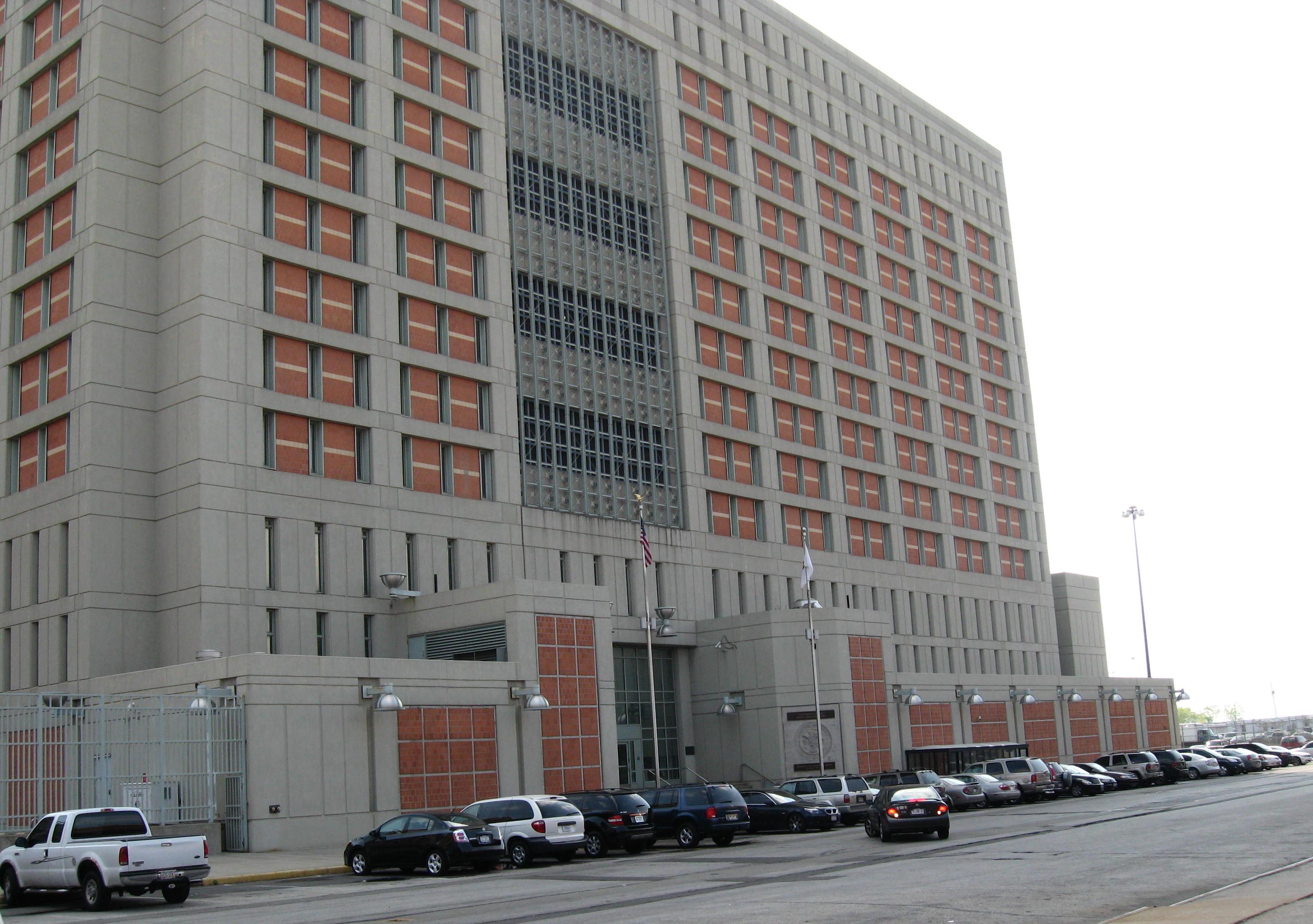
At the Metropolitan Detention Center in Brooklyn, two men have been sleeping across from each other for nearly 200 days.
One is Sean Combs. The other is Guo Wengui — also known as Miles Guo, also known as Ho Wan Kwok — convicted in July 2024 of nine federal counts including racketeering conspiracy, securities fraud, wire fraud, and money laundering for defrauding his followers of more than $1 billion. His sentencing remains adjourned. A Trump pardon would dissolve a $1.3 billion forfeiture order. Steve Bannon, his former $1 million-per-contract associate, broadcasts four hours a day from outside.(28)
The night before Combs's sentencing hearing, Guo filed a letter with the court vouching for a light sentence. "I've been with Mr. Combs now for close to 200 days where we sleep right across from each other," Guo wrote. He called Combs "the most motivated and influential" big-name inmate he had met at the facility. He described their shared plans to launch an AI platform aimed at helping at-risk youth and musicians when released. "I see Mr. Combs is a very kind, sensitive, genius person," Guo wrote. "He really cares about his name and his reputation."(29)
Guo also noted in the letter that he had previously met Sam Bankman-Fried and former Honduran President Juan Orlando Hernández — convicted of narco-trafficking — while in federal lockup at the same facility.
The Metropolitan Detention Center in Brooklyn currently houses or has recently housed simultaneously: a Chinese intelligence-affiliated fraudster whose sentencing has been adjourned for reasons not publicly explained, a hip-hop mogul convicted on charges involving the commercial exploitation of other people, a cryptocurrency founder who collapsed a $32 billion exchange, and a former head of state convicted of narco-trafficking. They are filing character reference letters for each other and planning joint business ventures from their cells.
This is not a prison. This is a node.
Each of these men — by radically different paths through radically different industries, in radically different decades — accumulated the same three things: compromising material on powerful people, networks that crossed between legitimate and criminal infrastructure, and relationships with law enforcement and state power that ran in both directions. The clandestine operation did not stop when the cell door closed. It found a new address.
The Epstein documents — managed at Treasury by Scott Bessent, documented in Article II of this series — are the subject of an active congressional subpoena the DOJ has not complied with. A bipartisan group of lawmakers gathered the 218 signatures required to force a vote on demanding their full release. Attorney General Pam Bondi briefed the House Oversight Committee and provided no information beyond what was already asked. The cover-up, as Rep. Stansbury stated on March 19, 2026, "is the Department of Justice, the attorney general, the president who is sitting on files and refusing to answer questions."(30b)
Rep. Melanie Stansbury — a member of the House Oversight Committee who reviewed unredacted portions of the files — stated on MSNBC: "Donald Trump is not only named over and over in them, he — it is discussed, this trial, in which he was accused of raping a 13-year-old at Epstein's house." She stated that Epstein wrote in a 2018 message: "It's wild, because I am the one able to take [Trump] down." In a 2019 email to biographer Michael Wolff, Epstein alleged Trump "spent hours" at his home with one of his victims and "of course he knew about the girls as he asked Ghislaine to stop." Stansbury has stated Trump is named over 1,600 times in documents received from the estate, including court filings, Maxwell correspondence, and bank transactions directly with Epstein.(30b)
The White House press secretary identified the alleged victim by name — a woman who died by suicide in 2024. Stansbury called it "convenient" and said: "This should be raising every hair on the back of your neck."
Rep. Melanie Stansbury, House Oversight Committee — "It's time to depose Donald Trump." March 2026.
→ To Catch A Predator: Crimes Against Children from Brooklyn to Gaza →
→ Article II: Asymmetry — The Records That Would Answer Every Question
— Rep. Melanie Stansbury, House Oversight Committee, November 2025
XI. The Through-Line
From Billie Holiday's hospital bed in 1959 to a federal detention center in Brooklyn in 2025 is sixty-six years. The same number of years Lisette Model's jazz photographs stayed buried.
The apparatus documented across those sixty-six years — FBI surveillance, CIA deployment, mob distribution infrastructure, federal drug enforcement as a political weapon, commercial catalog extraction, the asset/problem classification system — did not disappear. It evolved. The targets changed. The industries changed. The operators changed. The logic did not change.
What the logic produces, at full extension, is this: a room in a federal building where the men who ran the most sophisticated influence and extraction operations of their respective eras sleep across from each other and write each other letters. Somewhere above them — in the case management decisions, the sentencing adjournments, the selective pardons, the forfeiture orders that disappear or don't — the classification still runs. Asset or problem. The machine still decides.
The music was always the terrain. The question was always who controlled the infrastructure it moved through. That question has not been answered. It is still being decided, in courtrooms and in cells and in the hands of people whose names are not in the receipts below.
XII. What They Could Not Kill
Underneath everything documented in this article — underneath the surveillance files and the hospital arrests and the fifteen-minute inquests and the adjourned sentencings — there is a hidden America. Not the America of the State Department press releases or the FBI classification memos. The America that produced jazz in the first place. The America that took the most painful history any people had been handed and made from it the most irresistible culture the world had ever heard.
That America wanted to spread what it had. Not through war. Not through leverage or threat or the asset/problem binary. Through peace and music. Through the specific freedom that comes when a human being plays something true in a room and other human beings recognize it across every line the apparatus was designed to hold. That recognition was not a program. It was not a policy. It could not be classified or managed or deployed on a schedule. It just happened — in rooms, across borders, through iron curtains on radio waves, on bones pressed from X-ray film in apartments where people needed the music badly enough to make it from whatever was available.
That America was the real threat the apparatus was always managing. Not to Russia. Not to communism. To the apparatus itself. Because if the real America was the one in the music — integrated, joyful, free, crossing every line — then the apparatus protecting America from itself had no legitimacy. It was not defending the country. It was defending its own classification system against the country.
Freedom taken seriously is ungovernable. The apparatus knew this. It also knew that freedom taken all the way produces criminals — that the same liberty that produced Armstrong produced Lansky, that the same culture that gave the world Strange Fruit gave the mob its jukebox infrastructure. It used that truth to justify the controls. And it created the conditions for the crime it then used to justify the surveillance. The cycle was always self-generating. That was the design.
The apparatus couldn't kill the culture from outside. It tried for decades. Billie Holiday died handcuffed to a hospital bed and Strange Fruit outlived Anslinger by half a century. Sam Cooke's catalog was taken in three months and A Change Is Gonna Come was played at Barack Obama's inauguration. The FBI surveilled Duke Ellington for thirty-six years and he became America's most important composer. The culture survived everything thrown at it from outside.
So the apparatus waited. And eventually the culture produced someone who had learned its methods well enough to run them from inside.
Hip-hop was the direct descendant of jazz. The same lineage. The same community. The same history of surveillance, suppression, drug war destruction, file opening, license revoking, catalog stripping. NWA received a federal letter. Tupac and Biggie had FBI files. The crack epidemic — whose CIA connections Gary Webb documented and died trying to prove — hollowed out the same communities that produced the music. The apparatus ran the same playbook against hip-hop that it had run against jazz, updated for a new era.
And out of that history, carrying that memory, named by that pain — hip-hop became the most globally dominant American cultural export of the last thirty years. It spread the way jazz had spread. Not because a government program deployed it. Because it was true. Because people everywhere recognized something in it that no apparatus could manufacture.
Then Sean Combs built an empire inside it.
What the federal case alleges — charges that include sex trafficking and racketeering, to which Combs pleaded guilty to prostitution-related charges — is that the music became the clandestine operation. Not jazz surveilled by the FBI from outside. Not culture deployed by the CIA from above. The music itself allegedly turned into an internal surveillance and extraction apparatus run by one of its own operators. The freak-offs as kompromat. The recordings as leverage. The famous faces at the parties as assets to be managed. The label infrastructure, the debt structures, the control of access — the whole apparatus, replicated from inside the culture it was built inside of.
This is not irony. This is the apparatus completing itself. It colonized the culture not by destroying it but by producing operators who had learned its logic so completely that they ran it voluntarily. The jukebox economics of Meyer Lansky. The asset management of the booking agency. The classification system of the FBI. Running now not from a federal building but from a recording studio, a party venue, a cell in Brooklyn where a convicted Chinese intelligence-affiliated fraudster sleeps across the room and they plan AI platforms together.
Every generation has its version of the memory operation. The mechanism evolves. The goal does not. Separate people from the culture that makes them ungovernable. Make them turn on each other. Export the division globally as an alternative to the Americanization that already took hold everywhere — because you cannot un-ring that bell and the apparatus knows it. So the operation shifts from suppression to saturation. Flood the zone. Make everything feel compromised. Make the hidden America — the one that just wanted to play — feel like a naive fantasy from a past that probably wasn't as good as it seemed.
Black Lives Matter carried the direct lineage of everything in this article — Holiday, Cooke, COINTELPRO, the kneeling agents fired five years after the photograph. A genuine response to genuine documented violence. The apparatus did not kill it. It fragmented it, turned it into a culture war instrument, separated Americans from each other and from the through-line that made it legible. You fight about the symbol until you forget the substance.
COVID removed for two years the specific thing that made jazz dangerous to the apparatus in the first place — bodies in the same room, responding to the same sound, across every line the classification system was designed to hold. The shared physical experience that had integrated rooms, crossed borders, moved through iron curtains on radio waves and bones. When it came back, the landscape had been rearranged enough that some of what was known felt like a distant memory.
But you cannot kill what people knew. You can only make them doubt it long enough to stop defending it. The apparatus understood this in 1939 when it warned Holiday to stop singing Strange Fruit. It understood it in 1952 when it buried Lisette Model's photographs. It understood it in 1971 when it destroyed Sam Cooke's file. The record of what was real is the threat. The memory is the resistance.
The Cheka operatives in the header photograph built something they believed would last forever. It lasted five years before it was renamed. Then renamed again. Cheka. GPU. NKVD. KGB. FSB. The name changes. The leather jackets stay. The classification logic stays. The asset/problem binary stays. The secret as weapon stays.
What also stays: the thirty million listeners pressing their ears to radios in Moscow apartments. The bones with music cut into them. The photograph buried sixty-six years that got published anyway. The song about strange fruit that could not be unsung no matter how many federal agents stood at how many bedsides.
The hidden America wanted to spread freedom through music. What spread alongside it — underneath it, using it as infrastructure — was the extraction apparatus. The two traveled together for a hundred years. They are still traveling together now, in a cell in Brooklyn, in a sentencing that stays adjourned, in a pardon that would dissolve a forfeiture order, in a broadcast that runs four hours a day.
The apparatus feeds on secrets. It doesn't matter whose. But the culture feeds on something older and harder to extinguish. It feeds on the memory of what it felt like when the music played and the room was full and nobody was keeping count of who was supposed to be there.
Here is what the photograph in the header of this article does not show you: belief. Not real belief. What it shows you is men who had decided to become the performance of belief — the leather jacket, the invisible front, the selfless knight protecting the motherland's soul. The Cheka was not the real thing. It was a model of the real thing, assembled from mythology and dressed in the language of nobility and honor. Every apparatus that followed modeled itself on that model. COINTELPRO modeled itself on the national security state. The War on Drugs modeled itself on law enforcement. The asset management modeled itself on the music industry. Each one a copy of a copy, referring back through the chain to a founding myth that was itself a performance.
A model of nobility has no internal check. The real thing has consequences — the friction of actual belief, the weight of an oath that has to be answered for. The model only has the costume. And the costume can justify anything. The rape. The false flag. The hospital room with the handcuffs. The fifteen-minute inquest. The files that stay locked. The sentencing that stays adjourned. The statue rebuilt. All of it performed in the name of the motherland, the national security, the public health, the soul of the people — noble, honorable, necessary, selfless.
This is why the collapse is joint and has no single author. Nobody is running the web. The web runs itself, because every node learned the same model and is performing the same performance. The Chekist and the narcotics agent and the booking agent and the fraudster in the cell and the man planning an AI platform from across the room — they all learned the same binary. Asset or problem. They all learned the same costume. They are all, in their own way, singing the theme song. Where does the motherland begin. From the oath you swear to her in your youthful heart.
The competing world orders — East and West, Chekism and jazz diplomacy, organized terror and the land of the free — were both running models. Both performing the protection of something they had already hollowed out. The infatuation was mutual. The collapse is joint. And the warzone is the world.
We are keeping count.