
When the Israeli military justifies uprooting ancient olive groves by citing the need to clear "hiding places for fighters," it is using the same logic it deployed to level schools, hospitals, and entire residential neighborhoods. The same excuse — military necessity — has now been extended to the non-human world, rationalizing the destruction of ecosystems, bird migration corridors, wetlands, livestock, and centuries-old orchards that have nothing to do with armed resistance. The receipts are satellite images, UN agency reports, peer-reviewed science, and the statements of Israeli military commanders themselves.
This investigation compiles what is known — from the specific weapons deployed to the last documented numbers of surviving cattle, from the fate of Gaza's only nature reserve to the vineyards of Hebron razed days ago to expand a settler road — and situates it within the broader history of what warfare does to the natural world. Nothing in that history, at this scale and density, compares to what is happening now in Gaza.
The Arsenal Against the Earth
Understanding what has happened to Gaza's living world requires understanding what was dropped on it. More than 29,000 bombs have been confirmed, with regular use of 2,000-pound munitions — the largest class of conventional bomb in common deployment.[1] In October 2023 alone, the tonnage of explosives dropped on Gaza equaled approximately 1.5 times the explosive yield of the atomic bomb detonated over Hiroshima.[2] Between 5% and 10% of those weapons did not detonate on impact, meaning tens of thousands of unexploded ordnance now lie buried in Gaza's soil, farmland, and the rubble of its greenhouses.[1]
The confirmed weapon types, and their specific ecological effects:
📋 Weapons Deployed & Their Environmental Signatures
- White Phosphorus Human Rights Watch documented Israeli use of airburst white phosphorus munitions over both Gaza City and southern Lebanon, beginning October 2023.[3] White phosphorus burns at temperatures capable of melting metal, persists in soil and sediment for extended periods, renders agricultural land infertile, and enters water systems — contaminating the food chain from soil microorganisms upward through animals and fish.[4] Between October 2023 and October 2024, Israel carried out 195 documented white phosphorus strikes in Lebanon alone.[5] Palestinian agricultural authorities have accused Israel of deliberately targeting farmland with the substance, resulting in the accumulation of carcinogenic compounds in soils that will affect anyone who attempts to cultivate them for decades.[6]
- 2,000-lb JDAMs Blast fragments recovered on-site indicate the vast majority of bombs dropped on Gaza are US-manufactured. The blast radius of a 2,000-lb bomb is capable of destroying structures within 800 meters — which is why, at peak bombing intensity, 84% of Gaza's hospitals fell within the damage range of these weapons.[1] At soil level, detonation temperatures reach 2,000°C, incinerating soil microorganisms — the invisible biological foundation of all agriculture — and disrupting layered soil structures built over centuries.[7]
- Heavy Metals Contamination Munitions deployed across multiple conflicts in Gaza have already contaminated soils with elevated concentrations of cobalt and other heavy metals. The current campaign has dramatically expanded that contamination. A comprehensive accounting cannot be made because Gaza's laboratories are largely destroyed. Metals identified in wound tissue analysis from previous Gaza conflicts include lead, zinc, chromium, copper, platinum, titanium, cadmium, nickel, and vanadium — all of which pass from weapons into soil, water, and the bodies of anything living in the strike zone.[8]
- Fuel & Seawater in Tunnels Reports document Israeli military pumping of fuel and seawater into tunnel networks throughout Gaza. This is described by environmental analysts as a potential death blow to the coastal aquifer — the primary freshwater source for 2.1 million people and for whatever agricultural recovery might otherwise be possible.[9]
- Military Bulldozers IDF D9 armored bulldozers — Caterpillar machines modified for combat — have been used systematically to uproot orchards, raze farms, and flatten agricultural infrastructure across Gaza and, separately, in the West Bank. This is documented through satellite imagery, direct military statements, and testimony from farmers.[2]
The Land: Farms, Trees, and Orchards
Gaza before October 2023 was agriculturally self-sufficient in vegetables, eggs, milk, poultry, and fish, and produced significant quantities of olive oil and red meat.[10] By early 2025, less than 5% of its cropland was both accessible and undamaged.[11] The progression of destruction, tracked by satellite imagery and verified by the UN Food and Agriculture Organization (FAO) and the UN Satellite Centre (UNOSAT), documents not a war but an erasure.
By late February 2024 — less than five months into the campaign — satellite data showed the Israeli military had destroyed more than 65 square kilometers of farms and orchards, representing 38% of Gaza's total. Tractors, tanks, and military vehicles were documented uprooting orchards and fields. Two thousand agricultural sites were destroyed, often replaced with Israeli military earthworks. Of Gaza's 7,500 greenhouses, a third were entirely destroyed at that point; in the north, 90% were gone.[2]
By October 2024, damage had reached 67.6% of all cropland. By late July 2025, 86% of agricultural land was damaged, with most of the remainder inaccessible. Satellite analysis by Kent State University geographer He Yin, tracking vegetation loss through May 2025, found damage to 71–98% of annual crops and 90–94% of tree crops.[12] As Yale Environment 360 noted: "as most farms in Gaza span less than two acres, the loss of a single tree can be devastating."[13]
The olive tree — culturally, economically, and ecologically central to Palestinian life — has been specifically and repeatedly targeted. The FAO reports that approximately four in five of Gaza's olive trees have been burned or destroyed since October 2023.[10] The Nasser Odeh Olive Press Group, internationally certified and once producing 15–20 tonnes of olive oil a year from small Palestinian farms for export to the Gulf, has been "completely destroyed."[14]
— Al Jazeera correspondent Ibrahim al-Khalili, Deir el-Balah, October 2025
The Vineyard of Hebron and the Olive War
The pattern extends beyond Gaza. In the West Bank, the destruction of agricultural land is ongoing and accelerating. This week — May 2026 — Israeli forces bulldozed at least 400 dunams of vineyards in Hebron, uprooting some 40,000 grapevines. The purpose: expanding Route 60, a settler road connecting Israeli settlements across the West Bank. One family, the Tarwas — who have cultivated these vineyards for more than a century, and who have lost portions of their land to settlement construction in 1970, 1985, and 1995 — described watching everything razed. "We are left with nothing but sorrow at this sight," said Zuhur Tarwa.[15]
In August 2025, Major General Avi Bluth, head of the Israeli army's Central Command, ordered the uprooting of an estimated 10,000 olive trees in the West Bank village of Al-Mughayyir over three days — including trees up to 100 years old — following an alleged shooting incident nearby. Bluth stated the purpose was to ensure that "everyone is deterred — not only this village, but every village." The Israeli army confirmed the operation but denied it constituted collective punishment. Two leading Israeli human rights organizations immediately demanded a criminal investigation into the general on suspicion of war crimes.[16]
The scale of this campaign, accumulated over decades, is staggering. According to the head of the Palestinian Olive Council, since 1967 Israel has destroyed nearly one million olive trees in the West Bank. Between 2010 and September 2025, more than 250,000 trees were uprooted. Since October 2023, a further 56,000 were lost. The Palestinian Wall and Settlement Resistance Commission recorded 35,273 olive, grape, and fig trees uprooted, damaged, or poisoned in 2025 alone. "The scale of settler attacks on olive trees and farmers has quadrupled this year," the Olive Council chair stated.[17]
The Animals: A Near-Total Collapse
Gaza's livestock sector has been functionally annihilated. The numbers, sourced from the FAO, UNOSAT, and the Euro-Med Human Rights Monitor's field teams, describe what the Monitor calls "the near-total collapse" of Gaza's animal wealth through a combination of direct bombing, starvation, and deliberate destruction of feed, water, and shelter infrastructure.
📋 Gaza Livestock Losses — Before & After
- Cattle: Pre-war population approximately 15,000. As of FAO's assessment: 95% dead. Nearly all calves slaughtered.[18]
- Poultry: Gaza had approximately 6,500 poultry farms supplying 3 million chickens monthly to local markets. Over 93% of those farms are completely destroyed. Of the birds themselves: only 34,000 — roughly 1% — remain alive.[18]
- Sheep: Pre-war population approximately 60,000. Fewer than 25,000 remain (43%).[18]
- Goats: Pre-war population approximately 10,000. Approximately 3,000 remain (37%).[18]
- Donkeys and Working Animals: Pre-war population approximately 20,000. By August 2024, 43% had died. More recent data: no more than 6% remain. These animals became the primary mode of transport for displaced people, the injured, and the dead — after roads, vehicles, and fuel were all destroyed. They are almost entirely gone.[19]
Wild species face a parallel catastrophe. The Palestinian Environmental Quality Authority's assessment found that the conflict has put at risk 150–200 bird species, including endemic and migratory species that use the Gaza Valley as a critical staging point on one of the world's major flyways connecting Africa, Europe, and the Americas. Approximately 20 mammal species and 25 reptile species face conditions of near-complete extinction in the territory.[20]
The endangered Palestine sunbird — native to this region — is now rarely sighted in its former habitat. The Arabian gazelle has effectively disappeared from Gaza. A 2022 study by the Society for the Protection of Nature in Israel had already found a 40% decline in Gaza's biodiversity since the early 2000s; what has happened since October 2023 is orders of magnitude beyond that.[21]
Gaza's zoos — already operating under blockade conditions with limited resources — were bombed and destroyed. Animals that survived the strikes died of starvation and thirst. Surviving animals show behavioral changes consistent with severe trauma: hiding at the sound of aircraft, fleeing at the sound of explosions, in some cases attacking human remains due to extreme hunger.[22]
Wadi Gaza: The Reserve That Was Briefly Coming Back to Life
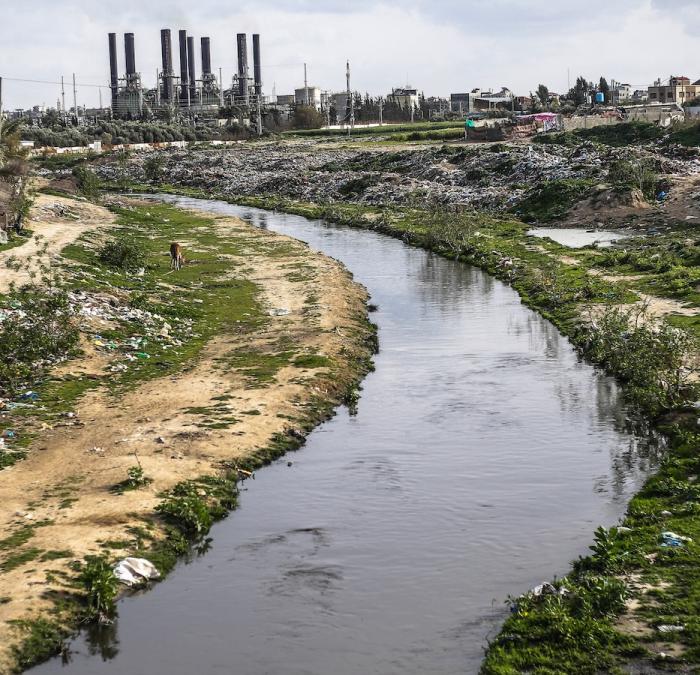
The stream flows west from Hebron through Israeli territory and on through Gaza into the Mediterranean — crossing every modern border in the region, indifferent to all of them. Gaza's only designated nature reserve, declared protected in 2000, it sits at the mouth of a 105-kilometer valley system on one of the world's busiest migratory flyways — a narrow land bridge joining Europe, Asia, and Africa along which an estimated 500 million birds travel each year.[23] Flamingos, herons, storks, cranes. They have been landing here longer than any of the politics that now determine whether this place exists.
For decades it was destroyed by blockade. Israeli restrictions prevented Gaza from building sewage infrastructure, so for thirty years the valley absorbed what 2.3 million people produced — raw effluent, construction debris, solid waste. Then in 2022 the sewage stopped. A new treatment plant came online, and the UN Development Programme committed to a ten-year, $66 million restoration effort — five local Gazan governments working together toward what the area's mayor called "a cultural, sporting and tourist attraction," a green belt, a lung for an imprisoned population with almost nowhere else to go.[24] The valley responded. Vegetation returned. Fish returned. And that same year, a Mediterranean monk seal was recorded off Gaza for the first time in recorded history — an animal that requires clean water to appear, arriving precisely because humans had briefly stopped poisoning the sea.[25]
The war erased all of it. Today Wadi Gaza is characterized by what Nada Majdalani, Palestinian director of EcoPeace Middle East, described simply as "pollution from debris, wastewater, corpses, ammunition, and explosives."[43] UNEP now estimates up to half of the reserve has been destroyed — double the 25% figure recorded in mid-2024, as damage continued accumulating with no access for monitoring or remediation.[44] Environmental damages to the reserve alone exceed $411 million.[26] The resources and access to them were long neglected before the people were.
"Wadi Gaza is the estuary of Nahal Besor, a stream mentioned in the Bible."
Water: The Infrastructure of Life, Systematically Dismantled
Gaza's water situation was already critical before October 2023 — 97% of underground sources failing WHO drinking water standards as recently as 2023. The war has collapsed whatever remained of the water management system entirely.[27]
There were eight wastewater treatment plants in Gaza. By May 2024, six had been damaged or destroyed. By February 2025, 73 of 84 sewage pumping stations had been destroyed.[2] The consequence: an estimated 130,000 cubic metres of raw sewage discharged into the Mediterranean Sea every day, turning one of the world's most historically rich coastal fisheries into an open sewer. The three sewage treatment plants rebuilt between 2022 and 2023 — the ones whose completion had briefly allowed a Mediterranean monk seal to appear off the coast — were all rendered non-operational within months of the war beginning.[25]
In Lebanon, the bombing additionally destroyed at least 34 irrigation pipeline networks between October 2023 and April 2025, and targeted 19 water treatment plants that previously supplied clean water to 60,000 people in the south.[28] In the city of Tyre alone, strikes on water distribution facilities left 400,000 people without safe water access.[28]
Lebanon: The Same Pattern, Expanding
Lebanon's National Council for Scientific Research, in a report presented by the environment ministry and covering the 2023–2024 conflict and subsequent escalations, formally accused Israel of "ecocide" — framing the environmental destruction not as incidental but as a systematic restructuring of ecosystems. Environment Minister Tamara el Zein wrote in the foreword that "the scale and intentionality of the damage to forests, agricultural lands, marine ecosystems, water resources, and atmospheric quality constitute what must be recognized as an act of ecocide, with consequences that extend far beyond immediate destruction."[29] The World Bank estimates total damage and recovery costs at over $25 billion.[29]
In southern Lebanon — an area whose economy is built on dispersed orchards, olive groves, and small-scale agriculture — the destruction has followed the Gaza template: orchards razed, water infrastructure targeted, white phosphorus deployed, rubble generated at massive scale. A farmer in the village of Kfar Kila described it simply: "There were great olive trees, a hundred years old or more. They uprooted everything, broke it all."[30]
BBC Verify documented the complete demolition of seven southern Lebanese towns, including Khiam, Deir Seryan, Taybeh, Markaba, Aita al-Shaab, Qouzah, and Naqoura. The construction demolition waste generated in Lebanon from this conflict was estimated at up to 100 million tons as of November 2024 — debris laced with asbestos, heavy metals, and unexploded ordnance.[31]
— Dr. Dan Steinbock, Modern Diplomacy, May 2026
Context: What War Does to Nature — and Why This Is Different
War has always been catastrophic for the natural world. The UN General Assembly declared November 6 the International Day for Preventing the Exploitation of the Environment in War and Armed Conflict — acknowledging that "over six decades, armed conflicts have occurred in more than two-thirds of the world's biodiversity hotspots."[32] A 2022 review of 193 case studies worldwide confirmed that aerial bombing destroys trees, disturbs soil structures, exterminates wildlife, and contributes to atmospheric and water pollution — and that "military leaders and personnel have shown little concern about these impacts."[33]
To situate what is happening in Gaza within that history:
| Conflict | Land Area Affected | Primary Ecological Mechanism | Recovery Timeline |
|---|---|---|---|
| Vietnam War (1961–75) | Agent Orange sprayed on 4.5 million acres; 17.8% of total forest cover destroyed; Vietnam forest cover declined 50% overall[34] | Chemical defoliation (dioxin), carpet bombing, napalm — but spread across a country of 330,000 km² | Dioxin persists in soil and food chain 50+ years later; some areas ecologically unrecoverable[35] |
| Syrian Civil War (2011–ongoing) | 20.4% of tree cover lost 2012–2019; fire affected 4.8% of Syria in 2019 vs average 0.2%; 60% of trees logged in some northern Aleppo areas[36] | Forest fires, illegal logging, agricultural collapse — distributed across 185,000 km² | Decades; 85% of agricultural land exposed to soil erosion[37] |
| Afghanistan (40+ years of war) | Some areas deforested up to 95%; loss of wetlands; widespread wildlife decline[38] | Deforestation for fuel, landmine contamination of pastures, collapse of environmental governance | Partially indeterminate; decades of ongoing degradation across 652,000 km²[39] |
| Gulf War (1991) | Iraqi forces discharged 5+ million barrels of oil into the Gulf; 500+ km² of coastline contaminated[33] | Oil contamination of marine and coastal ecosystems | Marine ecosystems recovered partially over 10–15 years |
| Gaza (Oct. 2023–present) | 80–98% of tree cover, annual crops, and tree crops damaged or destroyed within 365 km² — the most concentrated ecological destruction ever documented | Bombing, white phosphorus, military bulldozers, deliberate destruction of water/sewage infrastructure, starvation blockade — all simultaneously, in one of the world's most densely populated territories | FAO estimates $4.2 billion and decades for agricultural recovery alone; UNEP states some ecosystem damage is irreversible[10] |
The crucial distinction is density. Vietnam was destroyed across an entire country over a decade. Afghanistan degraded over forty years. Gaza — 365 square kilometers, roughly the size of a mid-sized city — has had 80% of its tree cover, 80–98% of its cropland, 97% of its animal wealth, and its only nature reserve obliterated in under two years. The UNEP debris estimate of 50 million tonnes represents, as former UN Mine Action head Pehr Lodhammar calculated, an average of 300 kg of rubble per square metre across the entire territory.[2] There is no modern parallel at this concentration.
The Legal Frame: Ecocide
Research group Forensic Architecture at Goldsmiths, University of London, and the Palestinian Environmental NGOs Network have called on the International Criminal Court to investigate the Israeli government under the Rome Statute's emerging war crime of ecocide — defined as "widespread, long-term and severe damage to the natural environment."[2] Three independent governments and research bodies — Lebanon's National Council for Scientific Research, Forensic Architecture, and a coalition of peer-reviewed academic institutions — have reached the same conclusion through independent analysis: this is not incidental destruction. It is structural.
The pattern documented in this investigation — deliberate targeting of orchards, water infrastructure, the only nature reserve, agricultural wells, greenhouses, fisheries, livestock, and migratory bird corridors — is consistent with what scholars of international law call environmental warfare: the use of ecological destruction as a weapon of collective punishment, displacement, and long-term subjugation. The Israeli army has, in multiple documented instances, stated this purpose explicitly. Major General Bluth ordered 10,000 olive trees uprooted to make Palestinians "pay a heavy price."[40] The stated logic is deterrence. The documented effect is ecocide.
⬤ What the Evidence Establishes
- Scale is unprecedented at this density: No modern conflict has destroyed 80–98% of agricultural capacity within 365 km² in under two years. Gaza's destruction per square kilometer exceeds anything documented in Vietnam, Syria, Afghanistan, or the Gulf War.
- The pattern is deliberate, not incidental: Destruction continued — and in many cases intensified — after military control of areas was established. Satellite imagery documents bulldozers operating outside active combat. Commanders stated explicitly they were destroying agriculture to punish and deter.
- The toxic legacy is generational: White phosphorus, heavy metals, dioxin-adjacent compounds, asbestos, and unexploded ordnance will remain in Gaza's soil, water, and food chain for decades or longer. Anyone who attempts to farm this land faces cancer risk. Children born on it face developmental harm.
- The same template is being applied in Lebanon and the West Bank: Orchards, irrigation infrastructure, water systems, and rural agricultural economies are being systematically dismantled using the same methods, the same justifications, and in some cases the same commanders.
- Recovery, if possible, requires conditions that do not currently exist: The FAO estimates $4.2 billion and decades for agricultural recovery — requiring heavy machinery (currently blockaded), fuel (currently scarce), mine clearance (14-year estimate), and soil remediation for which no timeline exists.
This article synthesizes documentation from the UN Environment Programme (UNEP), UN Food and Agriculture Organization (FAO), UNOSAT satellite analysis, Human Rights Watch, Amnesty International, Forensic Architecture (Goldsmiths), Euro-Med Human Rights Monitor, Yale Environment 360, Bloomberg Environmental Intelligence, Springer Nature peer-reviewed research, the Lebanese National Council for Scientific Research, the Palestinian Environmental Quality Authority, and the Palestinian Olive Council. All factual claims carry numbered citations to primary sources below. Where claims are disputed — e.g. Israeli military denial of collective punishment — both positions are noted. This article does not make claims beyond what documentation supports.
The Counter-Architecture of Survival
Amid all of this, Sulala Animal Rescue — the only functional animal rescue organization in Gaza — relocated from northern to central Gaza after the invasion and continues operating pop-up veterinary clinics in refugee camps. Its founder, Saeed Al-Err, described the psychological state of surviving animals: "When it comes to the animals, they are scared when they hear an airplane. Whenever a plane flies over, they run and try to hide."[41] His organization is one of the last institutions in Gaza still documenting and treating the non-human casualties of this war.
In Lebanon, researchers from the American University of Beirut have secured grants to begin soil sampling for heavy metals and phosphorus contamination — the first step toward understanding what will be required to make the land safe again. An agroecological center called "Together for the Olives of the South" is distributing olive saplings to displaced farmers.[42] Recovery, where it exists, is being built by individuals and small organizations, against enormous odds, without state support, in the shadow of continued bombing.
The natural world of Gaza — its migratory bird corridors, its Mediterranean coastal fisheries, its wetland reserve, its ancient olive groves, its farmland — existed for thousands of years before any of the political conditions that produced this war. The birds that stopped at Wadi Gaza during their passage between continents did not choose a side. The olive trees that stood for a century in Al-Mughayyir were not combatants. What has been done to them is a matter of documented, receipted record. What it means for the possibility of life in this territory — human and otherwise — is a question that will outlast the current cycle of conflict by generations.
Continue the Investigation
📎 Receipts — Primary Sources
- US bombs, 29,000+ figure, unexploded ordnance 5–10%, hospital blast radius: PMC — The Ongoing Environmental Destruction and Degradation of Gaza
- Hiroshima comparison, satellite farmland data, debris tonnage, bulldozers, tree cover 80%, ecocide call: Wikipedia — Environmental Impact of the Gaza War (citing UNEP, FAO, UNOSAT, Forensic Architecture)
- White phosphorus use in Gaza and Lebanon, HRW documentation: Human Rights Watch — Beyond Burning, Nov. 2024
- White phosphorus environmental persistence, soil infertility, water contamination: HRS — The Effects of the Weapons Used in Gaza
- 195 white phosphorus strikes in Lebanon, Oct. 2023–Oct. 2024: Middle East Monitor — Environmental Impacts of Israeli Bombs in Lebanon, Dec. 2025
- Deliberate targeting of farmland with white phosphorus, carcinogenic soil accumulation: Anadolu Agency — Chemical Attacks Threaten Gaza Agriculture, March 2024
- Soil incineration at 2,000°C, microorganism destruction: Galilee Foundation — The Current Environmental State of Gaza
- Heavy metals in wound tissue, cobalt contamination, metal list: PMC — Metals Detected in Wound Tissue of Gaza War Injuries
- Fuel and seawater pumped into tunnels, aquifer threat: Military Poisons — Poisoning Gaza
- Pre-war self-sufficiency, olive tree loss, $4.2B recovery estimate: AgTech Navigator / FAO — Agriculture in Gaza, April 2025
- 95%+ cropland unusable, FAO/UNOSAT assessment: Al Jazeera — More Than 95% of Gaza's Agricultural Land Unusable, May 2025
- Satellite analysis 71–98% crop damage: Yale Environment 360 — Up to 98% of Cropland Destroyed, June 2025
- "Loss of a single tree can be devastating": Yale Environment 360 — Gaza 95% of Farmland in Ruins, Oct. 2025
- Nasser Odeh Olive Press Group destroyed: Al Jazeera — Israeli Army, Settlers Target Palestinian Olive Harvesters, Oct. 2025
- Hebron vineyard, 40,000 grapevines, Route 60: Middle East Eye — Israel Uproots Thousands of Grapevines in Hebron, May 2026
- Al-Mughayyir, 10,000 trees, Bluth "pay a heavy price," human rights groups demand investigation: +972 Magazine — Israeli Army, Settlers Unite in Collective Punishment of Al-Mughayyir, Aug. 2025
- One million trees since 1967, 250,000 since 2010, 56,000 since Oct. 2023, attacks quadrupled: Al Majalla — Israel's Olive War Aims to Uproot More Than Just Trees
- Livestock collapse figures (FAO): FAO — Protecting Livelihoods and Lives in Gaza
- Donkey population collapse, 6% remaining: Euro-Med Monitor — 97% of Gaza's Animal Wealth Destroyed, Aug. 2025
- 150–200 bird species at risk, 20 mammal species, 25 reptile species, Gaza Valley as key flyway: Egypt Today / Palestinian Environmental Quality Authority, Aug. 2024
- Palestine sunbird, Arabian gazelle, 40% biodiversity decline: MS Research Hub — The Loss of Animal and Natural Life After War in Gaza
- Zoos destroyed, animals starving, behavioral changes: NPR — Gaza's Animals Starving in Besieged Zoos, Feb. 2024
- Wadi Gaza as Important Bird Area, nature reserve declared 2000, species count: Grokipedia — Wadi Gaza Nature Reserve
- $50M UN restoration project begun 2022, sewage stopped, ecology recovering: Yale Environment 360 — As War Halts, the Environmental Devastation in Gaza Runs Deep
- Mediterranean monk seal first recorded off Gaza 2022–23; plants destroyed by early 2024, sewage plumes: Yale Environment 360 — As War Halts, the Environmental Devastation in Gaza Runs Deep
- Wadi Gaza "wasteland," 25%+ destroyed, $411M environmental damage: Bloomberg — The War in Gaza Leaves Toxic Legacy, July 2025
- 97% of Gaza water failing WHO standards pre-war: Wodne Sprawy — Gaza Strip in Ecological Crisis, March 2025
- 34 irrigation pipeline networks destroyed Lebanon, 19 water treatment plants, Tyre 400,000 people: ARDD — Ecocide and Warfare in Southwest Asia: The Case of Lebanon, April 2026
- Lebanon ecocide report, Environment Minister el Zein, $25B total damage: Modern Diplomacy — Obliteration Ecocide from Gaza to Lebanon and Beyond, May 2026
- Kfar Kila farmer, 100-year-old olive trees uprooted: The Ecologist — Lebanon: The Environmental Aftermath, May 2025
- Seven Lebanese towns demolished (BBC Verify), 100M tonnes debris, asbestos: Genocide Watch — Ecocide and Domicide in Southern Lebanon
- Conflicts in two-thirds of biodiversity hotspots, UN International Day: UNEP — Why We Need to Protect Biodiversity from Harmful Effects of War
- 193-case study review, aerial bombing impacts, Gulf War oil spill: ScienceDirect — The Impact of Armed Conflict on Vegetation Dynamics
- Vietnam: 4.5 million acres Agent Orange, 17.8% forest cover: Wikipedia — Agent Orange
- Dioxin 50 years later, 24 vs 145–170 bird species in sprayed vs unsprayed forest: Wikipedia — Impact of Agent Orange in Vietnam
- Syria: 20.4% tree cover loss 2012–2019, 60% logging in northern Aleppo, 4.8% fire 2019: ReliefWeb / PAX — Axed and Burned: Conflict Deforestation in Syria
- Syria: 85% of agricultural land exposed to soil erosion: ScienceDirect — Syrian Crisis Repercussions on Agricultural Sector
- Afghanistan: deforestation up to 95% in some areas, wetland destruction: UNEP — Afghanistan
- Afghanistan degraded landscape, landmine contamination of pastures: VIF India — Climate Change & Environmental Degradation in Afghanistan
- Bluth: "pay a heavy price," human rights investigation demand: Mondoweiss — Israel Destroyed 10,000 Olive Trees in Al-Mughayyir, Aug. 2025
- Sulala Animal Rescue, animals fleeing at sound of aircraft: We Animals — The Soul of Gaza: Animals Amid War
- AUB soil research grant, "Together for the Olives of the South": Middle East Monitor — Environmental Impacts of Israeli Bombs in Lebanon, Dec. 2025
- Wadi Gaza "pollution from debris, wastewater, corpses, ammunition, and explosives" — Nada Majdalani, EcoPeace Middle East Palestinian director; Nahal Besor Biblical reference; 500 million birds flyway: Grist — Environmentalists in Israel and Palestine Fight to Save Cross-Border Water Resources, March 2025
- $66 million UNDP 10-year restoration, five local governments, mayor's "cultural, sporting and tourist attraction" quote: Times of Israel — Pollution Clean-Up Aims to Create Gaza's First Nature Reserve, February 2022
- Up to half of Wadi Gaza destroyed, UNEP 2024: Ambio / Springer Nature — Environmental Considerations for Post-War Reconstruction of Gaza, September 2025