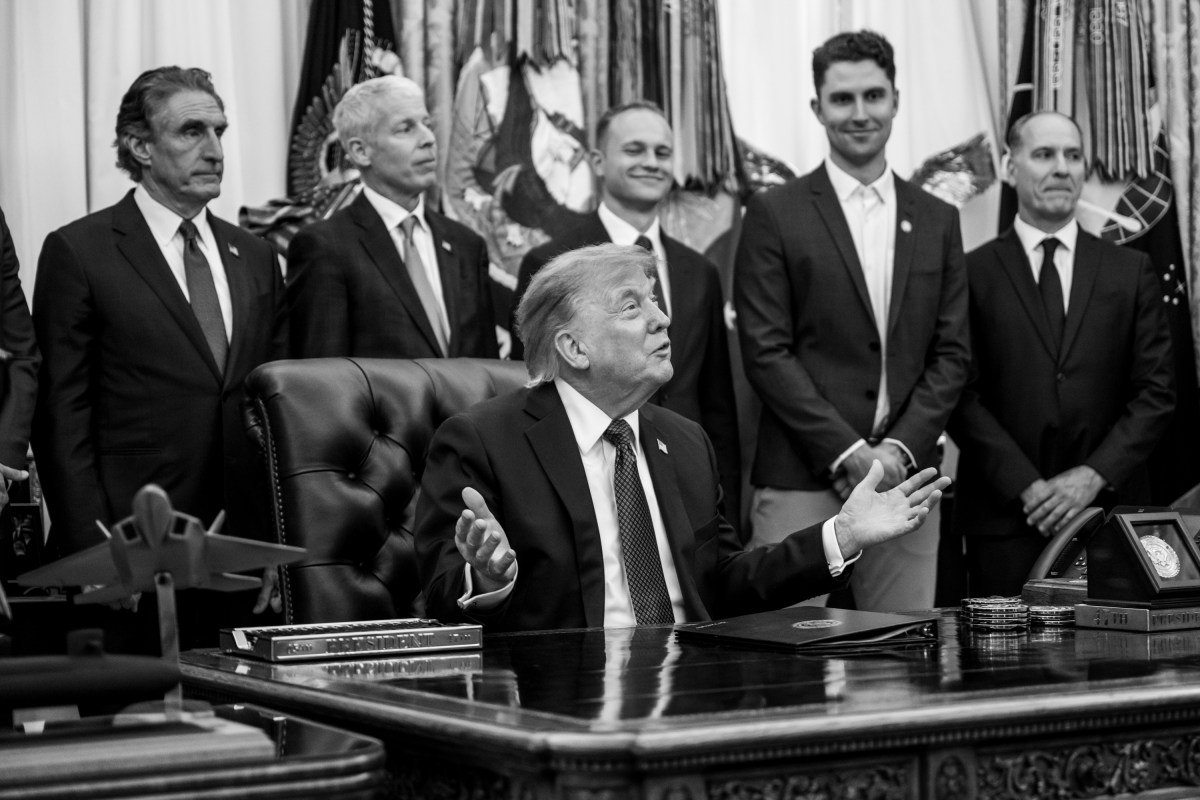
"I think I have like close to a billion dollars in the super PAC, and I'm allocating probably four or $500 million," the president said on 4 September 2026. "We're going to spend a lot of money because we don't want to lose our country." He added that he expected money to remain after November and could use it in 2028. MAGA Inc., the super PAC in question, reported $403.45 million in cash on hand as of 31 July 2026 in its most recent Federal Election Commission filing — less than half of the "close to a billion" the president claimed. Federal rules do not require the super PAC to spend down its balance this cycle.
The pledge landed after weeks of open frustration from Republican candidates in competitive races who had been waiting for the war chest to move. Sen. Jack Reed (D-RI), ranking member of the Senate Armed Services Committee, is not the only one drawing attention to a pattern that spans party lines and administrations. This article traces the pattern.
March 2020: A vote no one had to record
The CARES Act was signed on 27 March 2020. It appropriated $2.2 trillion — the largest single appropriation in American history at that moment. The Senate had passed it two days earlier by a recorded vote of 96–0. When the bill reached the House, leadership on both sides planned a voice vote — a procedural mechanism that produces no record of how any individual member voted.
Rep. Thomas Massie (R-KY) attempted to force a recorded vote. His stated rationale, in a series of tweets that morning: "I came here to make sure our republic doesn't die by unanimous consent in an empty chamber." And: "Is it too much to ask that the House do its job, just like the Senate did?" Both parties' leadership united to defeat his motion. Speaker Nancy Pelosi called him a "dangerous nuisance." House Minority Leader Kevin McCarthy went along with the voice-vote plan. President Trump attacked Massie on Twitter, calling him a "third-rate Grandstander" and demanding he be "thrown out of the Republican Party."
Massie's motion failed. The bill passed by voice vote. No individual House member's position on the largest appropriation in American history is on the public record.
The point is not Massie. Members force procedural fights all the time, and voice votes are a normal tool of legislative business. The point is that when one member tried to create individual accountability on a $2.2 trillion measure, leadership from both parties and the President personally converged to prevent it. That convergence — bipartisan on process, whatever the disagreements on substance — is the pattern this article is tracing.
The trades
In the weeks before the Act passed, senators traded.
📋 Documented senator trades, January–February 2020
- Kelly Loeffler (R-GA): Trades beginning 24 January 2020 — the day of an all-Senate closed-door briefing on the coronavirus threat. Initial disclosure $1.275M–$3.1M. A subsequent 31 March filing showed nearly $19 million in Intercontinental Exchange (ICE) shares sold. Her husband, Jeffrey Sprecher, chairs the New York Stock Exchange via ICE.
- Richard Burr (R-NC): Then-chair of the Senate Intelligence Committee. Sold $600,000–$1.7 million across 33 stocks between 31 January and 13 February 2020. Burr said he traded based on public news reports, specifically citing CNBC Asia health and science coverage.
- Dianne Feinstein (D-CA): Sold $1.5M–$6M in Allogene Therapeutics stock held by her husband, 31 January to 18 February. Assets said to be in a blind trust.
- James Inhofe (R-OK): Sold approximately $400,000 on 27 January. Denied attending the 24 January briefing.
- David Perdue (R-GA): Purchased approximately $185,000 in DuPont — a major PPE supplier — on the same day as a Senate briefing, then continued purchases through 2 March. Broader portfolio included Cardinal Health and Pfizer positions.
- John Hoeven (R-ND): Purchased approximately $250,000 in health sciences companies in January, five days after a briefing.
The Department of Justice cleared Loeffler, Feinstein, and Inhofe in May 2020. The Senate Ethics Committee dismissed complaints against Loeffler the following month. The Perdue investigation was closed in August 2020. The FBI executed a search warrant on Burr's cellphone; Burr stepped down as Intelligence Committee chair. His investigation was closed on 19 January 2021 — the final day of the first Trump administration.
Read against the CARES Act's downstream federal procurement, the trading record produces one direct overlap. Perdue's Pfizer holdings — up to $245,000 accumulated between January and early March 2020, per his own Senate disclosure — sat in a portfolio that would, five months later, benefit from the $1.95 billion Operation Warp Speed contract awarded to Pfizer in July 2020. Loeffler and her husband made no comparable purchases in specific Warp Speed contract recipients, but their DuPont position (up to $415,000 across four February–March transactions) plus $168,000 each in Citrix (teleworking software) and Oracle (which worked with the federal government on COVID response infrastructure per The New York Times) track the same pattern of positioning ahead of federal pandemic spending. The other four senators' documented holdings do not show comparable overlap with Warp Speed contract recipients on the public record: Burr's 33 sales were dominated by hospitality (Wyndham, Extended Stay America), rail (CSX), manufacturing (3M), telecom (CenturyLink), and banking (Bank of New York Mellon) positions; Feinstein's Allogene Therapeutics sale involved a cancer-therapy company; Inhofe sold Apple, PayPal, and Brookfield Asset Management; Hoeven's $250,000 BlackRock Health Sciences Trust II purchase was a diversified fund holding biotech and medical-device makers. The direct overlap between a senator's disclosed pre-CARES holdings and a specific Warp Speed contract recipient is Perdue's.
The contract architecture no one could see
Alongside CARES, the federal government stood up Operation Warp Speed. Total outlay: approximately $18 billion. The largest vaccine contracts were not written directly between the government and the pharmaceutical companies. They were routed through Advanced Technology International (ATI), a consortium intermediary, using a mechanism called Other Transaction Authority — a statutory carve-out originally designed for research and prototyping.
The consequence was structural: ATI is not a federal agency and is not subject to the Freedom of Information Act. NPR reported in September 2020 that FOIA requests for the contracts came back empty. The manufacturers were also shielded from civil liability by a Public Readiness and Emergency Preparedness Act declaration.
The public face of Warp Speed was Alex Azar, Secretary of Health and Human Services from January 2018 through January 2021. Before joining the government, Azar had been President of Lilly USA (2012–2017). At nomination, his portfolio was valued between $9.5 million and $20.6 million. His final year at Lilly paid approximately $2 million, plus a $1.6 million severance. During his tenure, the price of the company's insulin product Humalog rose approximately 300 percent. American Oversight sued HHS in 2020 for records of Azar's communications with Eli Lilly, Pfizer, AstraZeneca, and Johnson & Johnson — the companies whose contracts he was overseeing.
Contract values through ATI: Sanofi/GSK $2.10B · Pfizer $1.95B · Novavax $1.60B · AstraZeneca $1.60B · Moderna $1.50B · Johnson & Johnson $1.00B. Emergent BioSolutions received a separate $628 million BARDA contract for manufacturing capacity at its Baltimore Bayview facility. That facility would later be the subject of a contamination scandal — 15 million Johnson & Johnson doses lost — and a congressional oversight investigation.
Warp Speed's scientific lead, Moncef Slaoui, refused to divest fully from Moderna. The administration classified him as a contractor rather than an employee, exempting him from federal conflict-of-interest rules. According to House committee records released in September 2020 and reported by ProPublica, at least three other Warp Speed advisers — William Erhardt, Rachel Harrigan, and Carlo de Notaristefani — held stock in companies working on coronavirus vaccines, treatments, or tests. Erhardt and Harrigan owned shares of Pfizer.
January 2021: What closed, what didn't
January 2021 produced a compressed sequence of events that changed who was accountable for what.
On 5 January, Loeffler and Perdue lost their Senate seats in Georgia runoff elections.
On 6 January, both had been scheduled to object to certification of the Electoral College count. The Capitol was attacked that afternoon by supporters of the outgoing president. More than 140 police officers were injured in what became one of the largest mass attacks on law enforcement in American history. After the building was cleared, Loeffler withdrew her objection and voted for certification. Perdue was no longer a senator.
On 16 January, according to a Project On Government Oversight investigation published in May 2026, the Small Business Administration mass-cleared approximately 2.7 million PPP fraud flags on two specific days near the end of the first Trump administration. That total included 99.1 percent of the flags on loans over $2 million that had been flagged solely under size-based review criteria. Four days before the change of administrations.
On 19 January, the Justice Department closed the Richard Burr insider-trading investigation.
On 20 January, Joe Biden was inaugurated.
The Biden-era decisions
Ninety-nine days later, on 29 April 2021, the Justice Department's Office of Legal Counsel issued a legal opinion narrowing the jurisdiction of the Special Inspector General for Pandemic Recovery. The opinion excluded the Paycheck Protection Program, the Coronavirus Relief Fund, and the Payroll Support Program from SIGPR's oversight authority. SIGPR reported that the opinion caused it to terminate multiple audits. In its own reporting to Congress, SIGPR summarized the effect in one sentence: "The consequence is permanently reduced oversight." Congress did not clarify SIGPR's jurisdiction as the office requested.
That summer and fall, the Biden administration built a federal vaccine-mandate architecture as the Delta variant surged. On 9 September 2021, the president announced "Path Out of the Pandemic," which included executive orders mandating vaccination for federal employees and federal contractors, plus a directive to OSHA to require vaccination or weekly testing for private employers with 100 or more workers. On 4 November 2021, OSHA released its Emergency Temporary Standard (ETS), and the Centers for Medicare and Medicaid Services released a parallel rule for healthcare facilities receiving federal funding. The OSHA ETS covered approximately 84 million American workers; the CMS rule, approximately 17 million more.
On 16 December 2021, the president gave brief remarks in the Roosevelt Room. "For unvaccinated, we are looking at a winter of severe illness and death — if you're unvaccinated — for themselves, their families, and the hospitals they'll soon overwhelm." He took no questions.
On 13 January 2022, the Supreme Court ruled in NFIB v. OSHA. By a 6–3 per curiam vote, the Court stayed the OSHA ETS, finding that the Secretary of Labor lacked statutory authority to impose a workforce-wide mandate. In a companion case, Biden v. Missouri, the Court upheld the narrower CMS mandate for healthcare workers by 5–4, with Chief Justice Roberts and Justice Kavanaugh joining the three liberal justices. OSHA officially withdrew the ETS on 26 January 2022.
Both decisions were about the limits of executive-branch authority to impose broad-scale mandates in the absence of specific congressional delegation. The larger pattern they belong to is one this article is documenting: the CARES-era institutional decisions were made without recorded legislative accountability; the SIGPR narrowing was made by an executive-branch legal opinion; the mandates that followed were made by executive order and agency rule; the check on the mandates came from the judicial branch. Congress, in each case, was largely absent as the deliberative body the Constitution assigns for questions of this scale.
January 2025: The return
Trump was inaugurated for his second term on 20 January 2025. That evening, he signed Proclamation 10887, granting clemency to approximately 1,500 people charged in connection with the January 6, 2021 Capitol attack. Most received full and unconditional pardons. Fourteen people received commutations, including Stewart Rhodes, founder of the Oath Keepers, who had been sentenced to 18 years for seditious conspiracy, and — through the pardon rather than commutation — Enrique Tarrio, former chairman of the Proud Boys, who had been sentenced to 22 years. Rhodes was released from federal prison within hours. The proclamation also directed the Attorney General to dismiss all pending indictments related to January 6.
The proclamation's text characterized the previous four years as "a grave national injustice that has been perpetrated upon the American people" and framed the action as "a process of national reconciliation." In public remarks, Trump had for years described the defendants as "political prisoners" and "hostages."
On 19 February 2025, Kelly Loeffler was confirmed as the 28th Administrator of the Small Business Administration by a Senate vote of 52–46. Fifty-one Republicans and Sen. Jacky Rosen (D-NV) voted in favor. She was sworn in the following day.
The vehicle
To understand the Friday statement, the vehicle it flows through has to come into view.
Save America, Trump's leadership political action committee, was founded on 9 November 2020 — six days after the 2020 election. According to the January 6th Select Committee's findings, the Trump campaign and Republican National Committee raised approximately $250 million on election-fraud claims between election day and January 6, 2021. Most of that money went to Save America PAC rather than to actual legal challenges. Save America is the receptacle.
MAGA Inc., the super PAC Trump referred to on Friday, was founded on 23 September 2022 — six weeks before the 2022 midterm elections. In its founding year, Save America transferred more than $60 million to MAGA Inc. During the 2024 election cycle, MAGA Inc. spent over $376 million supporting Trump's campaign and opposing Kamala Harris and Joe Biden. Its single largest donor that cycle was Timothy Mellon, heir to the Mellon banking fortune, who gave approximately $150 million.
For the 2026 midterm cycle, MAGA Inc.'s reported donors include Kelcy Warren and his fossil-fuel pipeline company Energy Transfer ($25 million combined), casino magnate Miriam Adelson ($25 million), businesswoman Diane Hendricks ($25 million), Jeff Yass ($16 million, TikTok parent-company investor), crypto founders Cameron and Tyler Winklevoss ($15 million combined), venture capitalist Marc Andreessen ($9 million), Elon Musk ($5 million), Ronald Lauder ($5 million), Blackstone founder Stephen Schwarzman ($5 million), Foris DAX/Crypto.com ($35 million), UnitedHealthcare ($5 million pre-inauguration), and Sam Altman's Tools for Humanity ($5 million, while lobbying the administration on AI and digital identification).
Musk operates his own parallel vehicle. He purchased Twitter in October 2022 for $44 billion, took it private, and restored Trump's account in November 2022 — the platform Trump had been removed from following January 6. In the 2024 cycle, Musk spent approximately $278 million through his America PAC supporting Trump and Republicans. After Trump's inauguration he led the Department of Government Efficiency (DOGE), overseeing federal contract cuts across the same agencies where his companies held approximately $22 billion in cumulative federal contracts (per SpaceX President Gwynne Shotwell) and where SpaceX alone received $6.3 billion in 2024 federal awards. On 12 June 2026, Musk briefly became the world's first documented trillionaire during SpaceX's record IPO — the largest public offering in history — before his net worth pulled back below the mark. He publicly feuded with Trump in mid-2025, left the White House, then contributed $5 million to MAGA Inc. on 27 June 2025 anyway. On 2 September 2026 — two days before Trump's Oval Office pledge — Musk's America PAC disclosed its first 2026 midterm independent expenditures, roughly $800,000 across battleground Senate and House races. Two personally-controlled vehicles now deploy money into the same races.
The FEC filings also record a specific pattern of donations from individuals whose government business or family status changed shortly before or after their contribution:
📋 Documented donation timing patterns, 2025–2026
- Warren Stephens donated $1 million to MAGA Inc. in February 2025 — two weeks after his nomination as U.S. Ambassador to the United Kingdom was formally submitted to the Senate.
- Kamal Ghaffarian donated $1 million in April 2025. His company X-Energy announced its IPO within a week, the day after the White House issued a memo on nuclear power development that aligned with X-Energy's business.
- Elizabeth Fago, a health care entrepreneur, donated $1 million in April 2025. Weeks later, Trump granted her son — who had pleaded guilty to tax crimes — a full and unconditional pardon.
- Kelly Loeffler donated $2.5 million to MAGA Inc. on 25 June 2025, four months into her tenure as SBA Administrator. Her husband, Jeffrey Sprecher, donated $2.5 million the same day. Combined household contribution: $5 million. According to OpenSecrets, as of December 2019 the couple had donated a total of $3.2 million to all political committees over their entire history. The single-day June 2025 donation to MAGA Inc. exceeded their lifetime prior political giving.
Federal law prohibits federal contractors from making political donations. It does not prohibit political appointees, or private individuals with business before the government, from doing so.
The parallel front
Alongside the sequence traced above, the second Trump administration opened a second front — one directed at institutions the Constitution and long-standing statute had designed to be independent of the presidency. Two cases from the Kaleido Federal Litigation Index establish the shape.
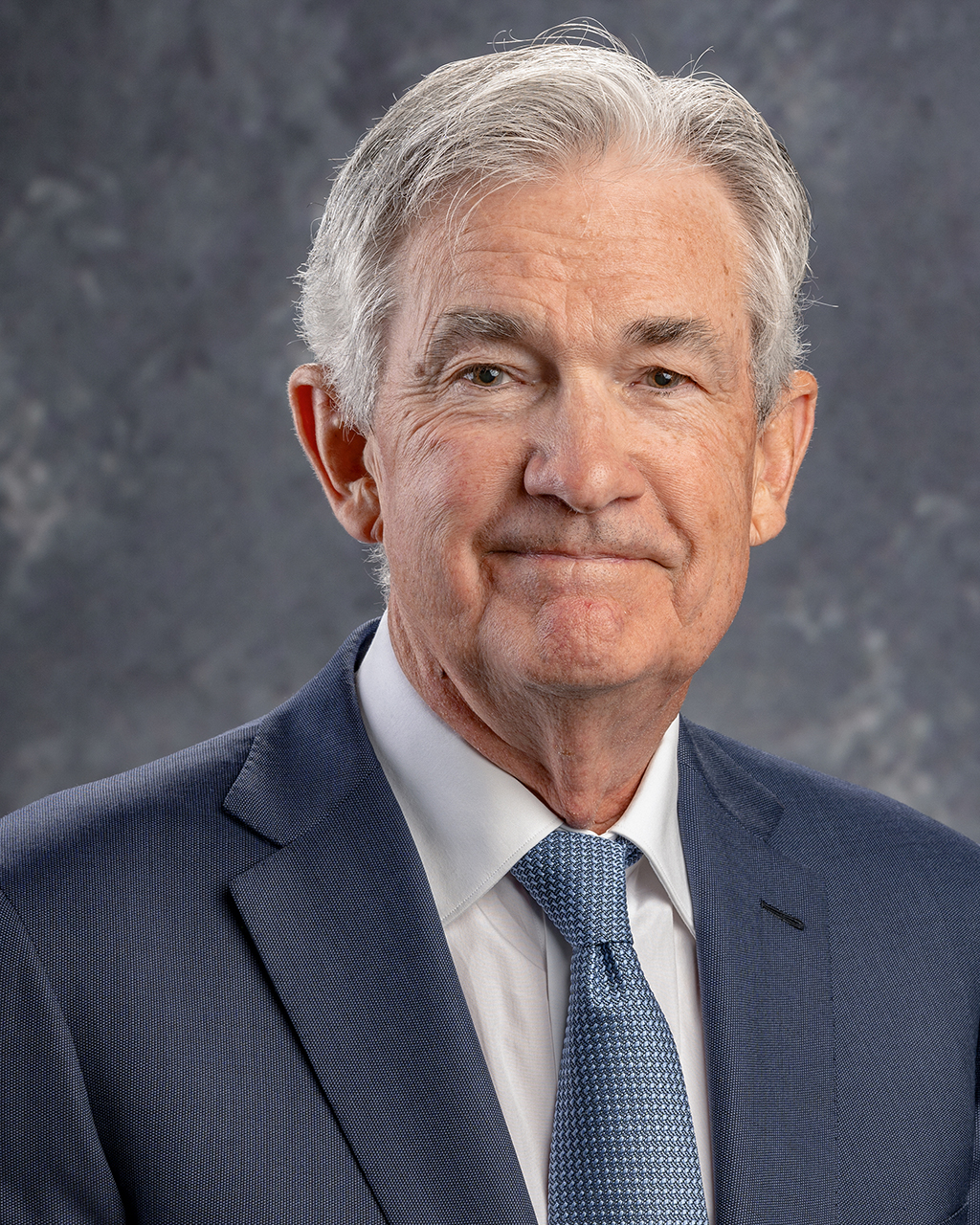
In re Grand Jury Subpoenas to the Board of Governors of the Federal Reserve System (D.D.C., No. 1:26-mc-00012-JEB). In November 2025, U.S. Attorney Jeanine Pirro approved a criminal investigation of Federal Reserve Chair Jerome Powell over Powell's public statements about the central bank's headquarters renovation. Pirro's office opened the case publicly on 11 January 2026. In the months preceding, Trump had said publicly that Powell had "mental problems" and that he would like to fire Powell for declining to lower interest rates — which the President cannot lawfully do absent cause under statutes governing Federal Reserve independence.
On 13 March 2026, Chief Judge James Boasberg of the D.D.C. quashed the grand jury subpoenas issued to the Federal Reserve. His written finding: there was "abundant evidence the subpoenas' dominant if not sole purpose was to harass and pressure Powell either to yield to the President or to resign and make way for a Fed Chair who would." He denied reconsideration on 3 April. Pirro dropped the investigation on 24 April 2026. On 8 May 2026, the government moved to vacate the earlier opinions — an attempt to remove the finding of improper purpose from the record after abandoning the case that had produced it. On 11 June 2026, Boasberg denied the vacatur motion. The finding stays on the record.
The objections came from both parties. Republican Senator Thom Tillis said that if there had been any doubt whether advisers were pushing to end Federal Reserve independence, there should now be none, and that the independence and credibility of the Justice Department itself were now in question; he said he would oppose any Fed nominee until the matter was resolved. Republican Senator Dave McCormick said the renovation may well have wasted taxpayer money — but congressional oversight was the proper venue for that question, not a criminal investigation.
Trump v. Cook (Supreme Court, No. 25A312). On 29 June 2026, decided together with Trump v. Slaughter, the Supreme Court by a 5–4 shadow-docket vote denied the President's application to stay a preliminary injunction blocking his attempted removal of Federal Reserve Governor Lisa Cook. Cook keeps her seat pending the merits of the challenge. The paired decisions overruled Humphrey's Executor — the 1935 case that had for ninety years protected independent-agency commissioners from at-will presidential removal — while carving out the Federal Reserve specifically. The removal route to controlling the Fed closed at nearly the same moment the prosecution route failed.
The Kaleido tracker adds one update, flagged as single-sourced and unresolved: on 13 August 2026, Steven Vandervelden, who ran the Powell investigation for Pirro's office, was reported to be overseeing a new special grand jury convened in D.C. Scope unknown. The tracker records this because the same prosecutor reappearing on a new investigative instrument is the pattern worth watching, not because any link between the two matters has been established.
The investigation was dropped. The finding stayed on the record. But a sitting Federal Reserve Chair had operated for six months under criminal investigation — an intimidation whose effect does not require the investigation to succeed, only that it exist.
April 2026: The referral
On 24 April 2026, the SBA under Loeffler referred 562,000 suspected fraudulent PPP and EIDL loans totaling $22.2 billion to the Treasury for collection. The agency described it as "the SBA's largest referral package on record." The announcement stated that the referral targeted loans "flagged for suspected fraud during the Biden Administration but never sent to Treasury for collection nor referred to DOJ."
Which is one way of describing loans that were flagged. Another way of describing some of them is: loans whose flags had been cleared, in mass batches, on 16 January 2021.
September 4, 2026: The same morning
At 11:00 a.m. EDT — hours before the president's Oval Office statement — the Federal Reserve announced the termination of a cease and desist order against Dallas-based United Texas Bank. The bank's 2024 enforcement action had cited "significant deficiencies" in anti-money-laundering compliance related to foreign correspondent banking and virtual currency customers. Crypto-industry advocates, including the Blockchain Association's Dan Spuller, had characterized the 2024 order at the time as part of "Operation Chokepoint 2.0" — the industry's term for what it described as coordinated Biden-era pressure on crypto-adjacent banks. The Fed also terminated a written agreement with Quontic Bank Acquisition Corp. and Quontic Bank Holdings Corp. that same day. The crypto-industry architecture underlying decisions like these is the subject of Kaleido's investigation Tethered Together: The Network.
The pattern, across two administrations
- The CARES vote wasn't recorded. Leadership from both parties, and the President personally, moved to prevent a member's attempt to force accountability on the largest appropriation in American history.
- The Warp Speed contracts weren't readable. Legal but structurally shielded from FOIA through a non-federal intermediary. Conflict-of-interest rules were avoided by classifying industry advisers as contractors.
- Fraud flags were cleared four days before Biden's inauguration. On January 16, 2021, the SBA cleared approximately 2.7 million fraud flags on pandemic loans, including 99.1 percent of size-based flags on loans over $2 million. POGO documented the timing in May 2026. Who authorized this and on what evidentiary basis is not on the public record. The SBA is now referring for collection loans it says were flagged and never referred; some overlap with the January 2021 clearances is likely.
- Oversight was narrowed by opinion. The Biden-era OLC excluded PPP, Coronavirus Relief Fund, and Payroll Support Program from SIGPR. SIGPR called it "permanently reduced oversight." Congress did not intervene.
- Executive-branch mandates were checked judicially. The Supreme Court stayed the OSHA ETS 6-3, holding that broad workforce-wide public-health authority required a specific congressional grant. Congress had not provided one.
- Clemency reset accountability at the executive level. The January 20, 2025 proclamation ended federal prosecutions of approximately 1,500 people charged in the Capitol attack, including seditious-conspiracy convictions.
- Independent institutions were tested by prosecutorial and removal power. A federal judge found in writing that the criminal investigation of the Fed Chair had been opened to harass and pressure him. The Supreme Court closed the removal route by 5–4 while overruling Humphrey's Executor and carving out the Fed. Objections came from both parties.
- Money now flows through two personally-controlled parallel vehicles. Save America and its successor MAGA Inc. hold roughly $400 million–$1 billion. Musk's America PAC operates in parallel, having spent approximately $278 million in 2024 and disclosing its first 2026 midterm expenditures two days before Trump's Oval Office pledge. Donation-timing patterns show at least four documented cases where large contributions coincided with pardons, appointments, or favorable federal action. The Loeffler-Sprecher household gave $5 million on a single day, four months into her SBA tenure.
The word "help"
The president used the word "help" to describe what he intends to provide to specific members of Congress before November. In a super PAC context, "help" refers to independent expenditures — advertising and organizing that must not be coordinated with the candidates it supports. The Federal Election Commission enforces the coordination bar.
The word also carries an older meaning in transactional contexts. Whether it applies here is not something the record settles. What the record does show is a sequence: a large appropriation was passed without a recorded vote; contracts were structured to be unreadable; senators traded and were cleared; fraud flags were cleared; oversight was narrowed; mandates were checked by the courts because Congress had not spoken; clemency was granted to defendants convicted of attacking the seat of Congress; independent institutions were tested by prosecutorial and removal power, and held only because federal judges refused to yield; one of the senators originally investigated became the administrator overseeing pandemic-loan collections; her household contributed five million dollars to the vehicle now pledging to help members of Congress who need help; and a second vehicle, personally controlled by another actor who briefly became the world's first trillionaire while overseeing federal contract cuts, is now spending on the same midterm races.
The pattern doesn't require a partisan reading. It requires only that the reader hold the sequence in view and ask what has been made accountable and what has not — and to whom.
This piece emerged from a working session on the Kaleido Federal Litigation Index — a tracker of 183+ current federal cases and executive-branch instruments across the second Trump administration. Its immediate trigger was the 4 September 2026 Oval Office statement; its underlying research spine was assembled across a sequence of documented anomalies spanning the CARES Act (March 2020), Operation Warp Speed (2020–2021), the January 2021 transition period, the Biden-era SIGPR narrowing and mandate architecture (2021–2022), the January 2025 mass clemency and cabinet appointments, the parallel Powell/Cook lawfare against Federal Reserve independence (2025–2026), and MAGA Inc. and America PAC's current donor and disbursement records. The Powell, Cook, DOGE, Musk, and January 6 pardon entries referenced above are tracked in the Kaleido Index. Every dated event is documented in publicly available sources. No causal claim is asserted beyond what the sequence itself establishes.