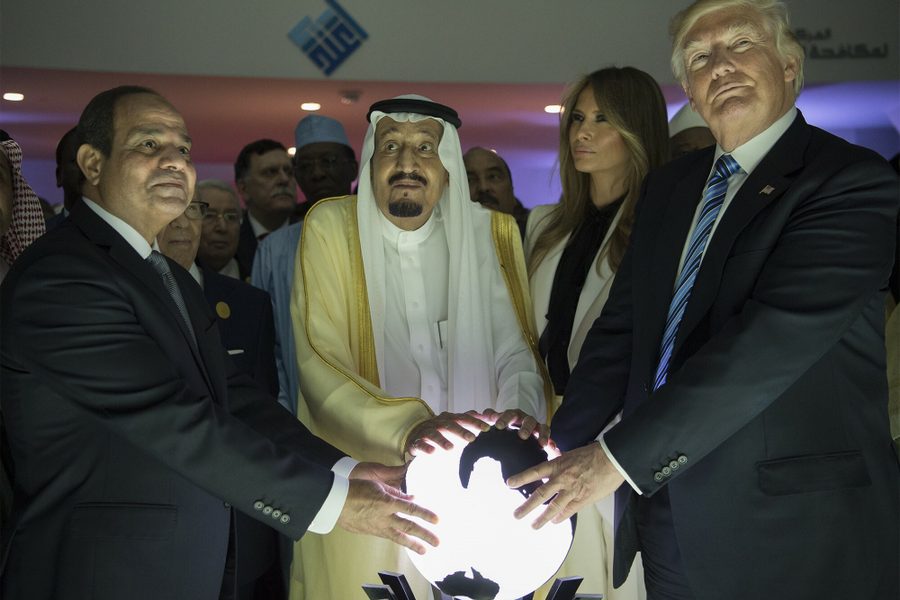
The Handshake That Never Ended
On February 14, 1945 — six weeks before the United Nations founding conference in San Francisco — President Franklin Roosevelt met King Abdul Aziz Ibn Saud aboard the USS Quincy in the Great Bitter Lake of the Suez Canal. Roosevelt was in a wheelchair. The King was 6'4", walked with a cane, and was half-blind from trachoma. According to witnesses, they hit it off immediately.
The King joked that Roosevelt was lucky to have a wheelchair — he could wheel himself anywhere. Roosevelt gave him one as a gift. Then they got down to business.
America needed an airport and naval refueling station for the war against Japan. The King needed security for his kingdom against rivals and against his own religious fundamentalists, who had already tried to overthrow him once. They agreed: the US would build a military base at Dhahran and guarantee the security of the Saudi monarchy. In return, the King guaranteed that the US would always have secure access to Saudi oil.
That same year, in San Francisco, the United Nations was founded on the promise that this kind of bilateral power deal — oil for military protection, resources for sovereignty guarantees — would be replaced by a multilateral rules-based order. A world where international law, not private arrangements between powerful men on warships, would govern the behavior of nations.
Both things happened in 1945. The deal and its alternative. And for eighty years, one of them has been governing the actual world while the other has been performing the governance of it.
The Architecture of the Arrangement
The Quincy deal didn't stay in 1945. Every American president reaffirmed it. Petrodollars recycled into US military hardware. American forces intervened when necessary to keep the kingdom safe. The Ikhwan — the fundamentalist warrior class that helped Ibn Saud conquer Arabia and then turned against his modernization — were suppressed with the implicit backing of American security guarantees.
When Saudi Arabia needed the arrangement to function discreetly, it sent Bandar. Prince Bandar bin Sultan served as Saudi Ambassador to the United States from 1983 to 2005 — through Reagan, Bush Sr., Clinton, and Bush Jr. He wasn't just an ambassador. He was the operating system of the relationship. CIA Director Bill Casey used Saudi petrodollars to fund covert operations. Bandar arranged $32 million for the Nicaraguan Contras. He negotiated the Iran-Iraq ceasefire. He met Osama bin Laden in the 1980s when bin Laden thanked him for securing American aid for the Mujahideen fighting the Soviets in Afghanistan.
Bandar described bin Laden at that meeting as "unimpressive and quiet." The same Mujahideen network that Bandar helped fund with Saudi petrodollars and CIA backing — the network that trained fighters in Pakistani border camps, that built the infrastructure of jihadist recruitment — became al-Qaeda. And fifteen of the nineteen hijackers who flew planes into the World Trade Center and the Pentagon on September 11, 2001 were Saudi nationals.
⚠ What The 28 Pages Showed
The 28 classified pages of the 9/11 Joint Congressional Inquiry — suppressed for 15 years and released in 2016 — showed indirect financial links between Saudi government officials and two of the hijackers. Bandar's name appears in them. Money from accounts connected to Bandar and his wife flowed through networks that reached the hijackers. The 9/11 Commission found "no evidence" of Saudi government involvement — language so carefully constructed it answers a different question than the one being asked. The specific connections documented in the 28 pages were not directly addressed.
George Herbert Walker Bush: The Man Who Built the Second CIA
To understand why Bandar bin Sultan would do anything for the Bush family — and why the Bush family would do anything for the Saudis — you have to understand what happened in 1976. Not 1945. Not 2001. 1976. The year Congress tried to kill the CIA and George H.W. Bush built something that couldn't be killed.
After Watergate, after the Church Committee exposed decades of CIA assassinations, domestic surveillance, and illegal covert operations, Congress moved to entomb the agency. The Hughes-Ryan Amendment required presidential approval for covert actions. Oversight committees were formed. The CIA was told, in effect: you answer to us now. CIA Director Stansfield Turner — appointed by Carter — then fired over 800 covert operatives in what became known as the Halloween Massacre. The agency was, as one observer put it, literally entombed.
George H.W. Bush had served as CIA Director for 355 days in 1976, appointed by Gerald Ford to restore morale after the Church Committee disaster. He did restore morale. He also did something else. With the CIA hamstrung, Bush — working with Saudi intelligence chief Kamal Adham — quietly blessed the construction of a parallel system. It was called the Safari Club.
The Safari Club — 1976
A clandestine alliance of intelligence services — Saudi Arabia, France, Egypt, Morocco, pre-revolutionary Iran — formed specifically to do what the CIA was now legally prohibited from doing. They ran proxy wars across Africa, armed rebel factions, assassinated targets, and coordinated Cold War operations outside the jurisdiction of American democracy. The funding came entirely from Saudi petrodollars. The bank that moved the money was BCCI — the Bank of Credit and Commerce International — which investigators later described as "a global intelligence operation" with a 1,500-employee black network running assassinations, extortion, and kidnapping. CIA Director George H.W. Bush had a personal account at BCCI. French customs found it after raiding the Paris branch.
Prince Turki Al-Faisal, the head of Saudi intelligence, described it plainly in a 2002 Georgetown speech: "In 1976, after the Watergate matters took place here, your intelligence community was literally tied up by Congress. It could not do anything. In order to compensate for that, a group of countries got together... and established what was called the Safari Club."
Saudi Arabia was the banker. France provided technology. Egypt and Morocco supplied troops. And George H.W. Bush — with plausible deniability built into every layer — provided the tacit blessing of the most powerful intelligence service in the world while it was officially prohibited from acting.
This is the psychological key to everything that follows. Bush didn't just work with the Saudis. He owed them. The covert operations infrastructure that kept the American empire functioning during the Carter years — the years when Congress thought it had won — ran on Saudi money. The Quincy deal had mutated into something deeper: the US military and intelligence apparatus had become structurally dependent on Saudi financing for its most important operations. You cannot threaten the people who fund your shadow government. You cannot hold them accountable. You can only protect them.
Bandar and Bush Sr.: How Two Intelligence Officers Recruited Each Other
Bandar bin Sultan arrived in Washington in 1983 as Saudi Ambassador. He was 34 years old, a fighter pilot trained at Maxwell Air Force Base in Alabama, a man who had spent time in America and understood its power geometry from the inside. Bush was then Vice President — widely dismissed, as Bob Woodward later wrote, as a wimp living in Ronald Reagan's shadow.
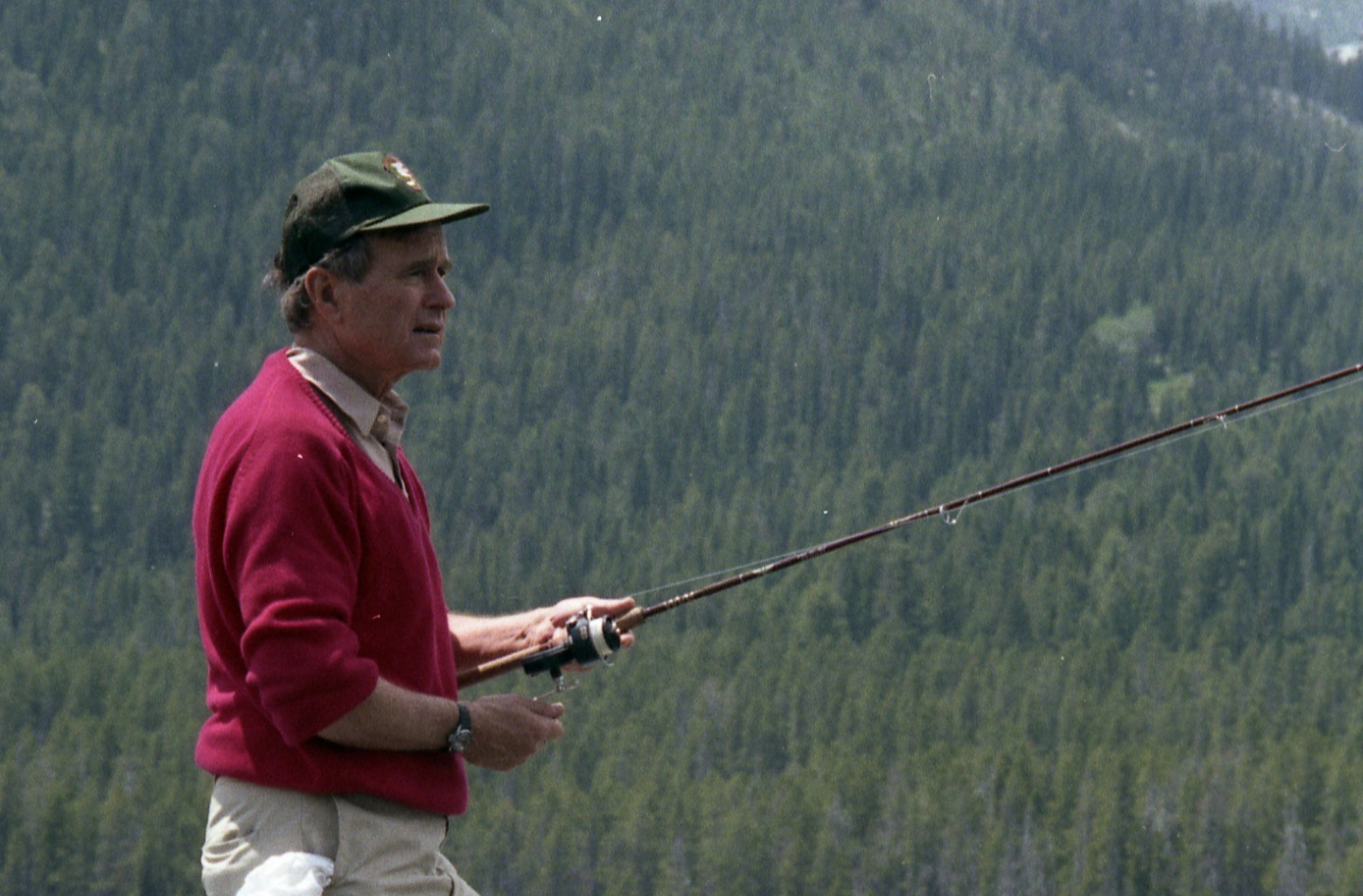
Bandar did something that changed everything. He treated Bush with the deference and respect of a man who would one day be president. He hosted lavish parties for him at his palatial estate overlooking the Potomac. He went fishing with him at Kennebunkport — Bandar's least favorite activity, but Bush loved it. He showed up. He was consistent. He made Bush feel seen.
"Like good intelligence officers — Bush had been CIA director and Bandar had close ties to the world's important spy services — they had recruited each other. The friendship was useful and genuine."
That phrase — they had recruited each other — is the entire relationship in four words. This was not friendship. It was mutual intelligence work conducted at the level of personal warmth. Each man understood what the other was. Each man understood the value of the other. And because the relationship was genuine as well as useful, it was unbreakable.
When Bush ran for president in 1988, Bandar was there. When Bush launched the Gulf War in 1991 to push Saddam out of Kuwait — protecting, among other things, the Saudi oil fields and the Saudi monarchy — Bandar was virtually a member of the war cabinet. When Bush lost to Clinton in 1992 and was calling Bandar at 4am on election night, Bandar was there.
And in 1997, when Bush called Bandar to say that his son George W. — then governor of Texas, preparing a presidential run, needing to learn foreign policy — would like to talk, Bandar came. Bush Sr. asked Bandar to tutor his son in the geopolitics of the world. The man who ran the shadow CIA's Saudi financing arm became the foreign policy mentor of the next President of the United States.
George W. Bush was so close to Bandar that the Prince earned a nickname inside the White House: Bandar Bush.
The Business Under the Friendship
Craig Unger's 2004 book House of Bush, House of Saud documented what ran beneath the personal relationship: Saudi interests paid not less than $1.477 billion to persons and entities in the Bush circle over two decades. Prince Bandar personally donated $1 million to the Bush Presidential Library in Texas. The Mahfouz and bin Laden families — the same families whose names appear in the BCCI files, the Afghanistan mujahideen records, and the 28 pages — bought into the Carlyle Group, the private equity firm where Bush Sr. and James Baker served as paid advisers through the 1990s. Carlyle, in turn, owned Vinnell Corporation — the company that had been training the Saudi National Guard on behalf of the US military since the early 1970s.
George W. Bush's first oil company, Arbusto, received a $50,000 investment from James Bath, a Texas businessman who served as North American representative for Salem bin Laden — Osama's older brother — and for Khalid bin Mahfouz, a BCCI insider. The money likely came from bin Laden-bin Mahfouz funds.
This is the financial anatomy of the Quincy deal by 1990. It had moved from a handshake between heads of state on a warship to a web of private equity investments, defense contracts, presidential libraries, oil partnerships, and off-books intelligence financing so dense that no individual transaction could be cleanly traced and no individual actor could be held accountable for the whole.
The Project for the New American Century: The Plan That Needed a Pretext
In June 1997, a group of Republican foreign policy thinkers — veterans of the Reagan and Bush Sr. administrations, cooling their heels during the Clinton years — founded a think tank called the Project for the New American Century. PNAC. Among its founding signatories: Dick Cheney, Donald Rumsfeld, Paul Wolfowitz.
Their stated goal was "American global leadership" — the maintenance of US military preeminence into the next century. Their specific obsession, from the beginning, was Iraq. In 1998, they sent an open letter to President Clinton demanding the removal of Saddam Hussein. Ten of the eighteen signatories of that letter would later serve in the George W. Bush administration.
In September 2000 — thirteen months before 9/11 — PNAC published its grand strategy document: Rebuilding America's Defenses. It called for US military dominance across every domain — land, sea, air, space, and cyberspace. It called for regime change in Iraq. And it contained a sentence that became, in retrospect, the most consequential single sentence in modern American foreign policy:
"Further, the process of transformation, even if it brings revolutionary change, is likely to be a long one, absent some catastrophic and catalyzing event — like a new Pearl Harbor."
Thirteen months later, Cheney was Vice President. Rumsfeld was Secretary of Defense. Wolfowitz was his deputy. And at a cabinet meeting the morning after 9/11 — before it was established who was responsible for the attacks — Rumsfeld insisted that Iraq should be "a principal target of the first round of terrorism." Bob Woodward reported it. It is in the record.
The PNAC signatories did not manufacture 9/11. That is not the claim here. The claim is simpler and more disturbing: they had a plan that required a catastrophic event to become viable, and when a catastrophic event occurred, they implemented the plan within hours of its occurrence, against a country they knew was not responsible for it.
And the country that was connected to the hijackers — the country whose money appears in the 28 pages, whose citizens made up 15 of the 19 attackers, whose ambassador sat on the Truman Balcony two days after the attacks — was immediately reaffirmed as America's closest ally. Because the Safari Club relationship meant that the US and Saudi Arabia were not just friends. They were structurally fused. You cannot prosecute the people who fund your shadow government. You can only protect them.
Four Days Apart: Two Speeches, One Stage Set
On September 19, 2003, Prince Bandar bin Sultan spoke at the World Affairs Council in San Francisco — the city where the UN was founded. 68 views on C-SPAN. He said: "And uh.. initially we were working hard on the priority, which is finding those evil people..." Eighteen days before his 9/11 Commission interview.
On September 23, 2003 — four days later — President George W. Bush addressed the United Nations General Assembly in New York. This is what he said:
Study the architecture of that speech for a moment. It constructs a moral sorting machine — terror versus civilization, with no neutral ground — and then uses that machine to retroactively validate every action already taken, including bypassing the Security Council to invade a country that had no weapons of mass destruction and no operational connection to the 9/11 attacks.
The phrase that does the most work and receives the least attention: "a coalition of nations acted to defend the peace, and the credibility of the United Nations." They invaded Iraq to defend the UN's credibility. The institution that voted against the invasion. The institution whose weapons inspectors were still working when the bombs dropped. The institution whose credibility, according to the man who bypassed it, required bypassing it.
This is not hypocrisy. Hypocrisy implies the speaker knows the distance between their words and the truth. This is something more clinical: the construction of a closed rhetorical system in which every challenge to the argument becomes evidence for it. Oppose the invasion? You're ignoring the threat of terror. Question the WMD claim? You're giving terrorists the chance to regroup. Cite the Security Council's opposition? The Security Council was "right to vow serious consequences" — and we delivered them.
Four days earlier, in the city where the UN was born, Bandar bin Sultan had spoken to 68 people about finding "those evil people." His 9/11 Commission interview was eighteen days away. The man who was the operational center of the US-Saudi relationship for twenty-two years — whose wife's accounts are in the 28 pages, whose phone numbers were in al-Qaeda operatives' books — was about to sit before the body investigating the worst attack on American soil. No recording. No transcript. Blanket absolution.
The institution built to prevent this kind of war was used as its stage set. Twice in four days. In two different cities. To two very different audiences. One of whom nobody was watching.
1991–2003: When the UN Became a Weapon — And Everyone Knew It
Between the Gulf War and the invasion, something happened that has been almost entirely erased from how the Iraq War is remembered. The United States — through the UN Security Council — imposed the most devastating sanctions regime in modern history on 23 million Iraqi civilians. And then, when it became undeniable that children were dying from contaminated water and preventable disease, the Clinton administration called that outcome a "hard choice" and decided it was "worth it."
The person who said this on camera, to a national television audience, was Madeleine Albright — then US Ambassador to the UN, later Secretary of State. In a 1996 CBS 60 Minutes interview, correspondent Lesley Stahl put it plainly: "We have heard that a half million children have died. I mean, that's more children than died in Hiroshima. And, you know, is the price worth it?"
"I think this is a very hard choice, but the price — we think the price is worth it."
Denis Halliday, who ran the UN humanitarian program in Iraq for 34 years, resigned in 1998 in protest. He called what was happening "genocide." His successor, Hans von Sponeck, also resigned in protest. The sanctions had destroyed Iraq's water treatment infrastructure, its medical supply chains, its electrical grid. Iraq was allowed to buy a sewage treatment plant but blocked from buying the generator to run it. Three hundred thousand tons of raw sewage poured daily into Iraq's rivers — into the water its children drank.
The Clinton administration's answer to this humanitarian catastrophe was the Oil-for-Food Programme — established in 1995, first shipment in December 1996. Iraq could sell oil; the revenue would go into a UN-controlled escrow account; the UN would purchase food, medicine, and humanitarian goods. The institution built to prevent wars would now administer the slow strangulation of a civilian population in between them.
Oil-for-Food became the largest humanitarian program in UN history. It also became, as the Paul Volcker independent inquiry later documented, the largest corruption scandal in UN history. Saddam Hussein skimmed an estimated $10–11 billion from the program through kickbacks, oil smuggling, and systematic overcharging — with the complicity of over 2,000 companies in 66 countries. The UN's own program director, Benon Sevan, was later indicted for bribery. Kofi Annan's son Kojo received payments from a company that won the inspection contract. The UN's internal auditor was told an investigation would be "too expensive to be worthwhile." The documents were shredded.
And here is the detail that a US Senate investigation eventually surfaced and that almost no one remembers: American oil purchases accounted for 52% of the kickbacks paid to Saddam Hussein's regime through the Oil-for-Food program — more than the rest of the world combined. The US was the primary funder of the corruption it was publicly denouncing. The same administration that said half a million dead children was "worth it" was simultaneously the largest source of revenue for the regime it was trying to strangle.
This is not incidental. This is the structural logic of the arrangement made visible. The Quincy deal said: we guarantee your security, you guarantee our oil. The sanctions said: we will use the bodies of your children as leverage against your government while our companies continue doing business with your oil. Oil-for-Food said: we will administer the humanitarian relief program for the suffering our sanctions caused and skim 52% of the corruption from it ourselves.
When the PNAC signatories needed a pretext to finally invade Iraq and complete the plan Wolfowitz had drafted in 1992, they had a ready-made moral case: Saddam had corrupted the humanitarian program. The UN had failed. The sanctions hadn't worked. Only military force would do.
Every part of that argument was true. And every part of it was engineered by the people making it.
The Through-Line: Humanitarian Infrastructure as Political Weapon
1991: Sanctions imposed. UN becomes enforcement mechanism. 1995: Oil-for-Food created — UN administers humanitarian relief for the crisis the US caused. 1996: Albright says children dying is "worth it." 1998: Two UN humanitarian coordinators resign calling it genocide. 2003: Invasion. Oil-for-Food terminated. Corruption scandal erupts — used to justify both the invasion and demands for UN reform. 2025: USAID gutted. UN announces it cannot sustain its humanitarian architecture. Palantir steps in. The logic from 1991 to 2025 is unbroken: create the humanitarian crisis, administer its relief, corrupt the administration, use the corruption to justify dismantling the institution, and replace it with private infrastructure answerable to no one.
September 13, 2001: The Truman Balcony
Two days after 9/11, American airspace was locked down. No civilian flights were permitted. Prince Bandar bin Sultan visited the White House. He and President George W. Bush went out to the Truman Balcony for a private conversation. Shortly after that meeting, approximately 140 Saudi nationals — including members of the bin Laden family — were evacuated from the United States on flights that were authorized while American citizens still could not fly.
The next day, Bush told the American people: "The Saudis are our friends."
On September 18, 2003 — two years later, six months after the Iraq invasion, the WMD story already unraveling — Bush met King Abdullah of Jordan at Camp David.
On September 19, 2003, Bandar spoke at the World Affairs Council in San Francisco — the city where the UN was founded, where the alternative to the Quincy deal was supposed to have been built. He talked about colonization, the private sector, oil. He said: "A handshake started it all."
Eighteen days later, he sat before the 9/11 Commission.
"And uh.. initially we were working hard on the priority, which is finding those evil people and continuing to prevent them from repeating what they've done."
That "And uh.." is not a diplomat's pause. That is a man choosing his next word very carefully in public, while knowing exactly what he knows in private. A man who had been inside the architecture for twenty years, speaking to an audience he knew would not ask the question he was actually answering.
The Institution Built to Prevent This
The United Nations Human Rights Council currently includes Saudi Arabia as a member. The same institution whose Special Rapporteur Francesca Albanese called Palantir's Gaza operation "a monstrosity" — the same institution that was supposed to replace bilateral power deals with international law — has Saudi Arabia adjudicating human rights.
This is not irony. This is the Quincy deal institutionalized. The UN was never going to be the alternative to that handshake because the handshake preceded the UN and the people who made it also built the UN.
Today, in 2026, the UN is restructuring itself under "UN80" — its 80th anniversary reform initiative. The Under-Secretary-General for Policy, Guy Ryder, briefed member states on a Friday morning that the complexity of the work has been "challenging for Member States to stay on top of." The headline that emerged from that briefing: Duplicated UN humanitarian efforts 'no longer sustainable.'
That briefing generated zero press coverage. A senior UN official acknowledging the collapse of the humanitarian coordination system — on the same week that two American aircraft carriers positioned for a potential strike on Iran — and it did not appear in the news.
The invisibility is not an accident. The people responsible for the system's failure are invisible by design. If nobody knows Guy Ryder exists, nobody asks what happened on his watch. If Guterres gives a speech that gets no coverage, he can say he spoke without anyone measuring the gap between his words and outcomes.
The Privatization of the Vacuum
When DOGE gutted USAID — the US Agency for International Development that was the single largest funder of the UN humanitarian coordination system — it didn't just cut programs. It removed the financial backbone of the architecture that held the system together. The UN couldn't replace that funding. So it announced a "bold overhaul." Which is bureaucratic language for shrinking what can no longer be afforded.
Into that vacuum walked Palantir. The data analytics company with deep Pentagon ties now has a permanent desk at the Civil Military Coordination Center in southern Israel — the US-led body ostensibly managing humanitarian aid delivery to Gaza. Palantir is providing, as Drop Site News reported, "the technological architecture for tracking the delivery and distribution of aid."
Aid delivery. Subordinate to data collection. The humanitarian architecture that USAID funded, that the UN coordinated, that was supposed to be the institutional expression of the Quincy deal's better angels — is now a Palantir product.
ARAMCO extracted Saudi oil. Palantir extracts Gaza data. The extraction logic is identical. Only the resource changed.
Howard Lutnick: The Man Who Survived
On September 11, 2001, Howard Lutnick was dropping his five-year-old son off at his first day of kindergarten. That is why he is alive. Every one of his 658 employees at Cantor Fitzgerald — including his younger brother Gary — were in the office on the 101st through 105th floors of the North Tower when the plane hit. None of them could get out.
Lutnick became the face of 9/11's financial grief. He rebuilt Cantor Fitzgerald. He donated $180 million to victims' families. He became the champion of the 9/11 families who were still, two decades later, trying to establish Saudi government responsibility for the attacks.
When Trump named him Commerce Secretary, those families saw an opening. Here was a man with personal losses, personal rage, and now the ear of a president who had spent years implying he knew things about Saudi Arabia that his predecessors had hidden.
What the Epstein files have since revealed is a different picture.
Lutnick was Epstein's neighbor. He visited Epstein's private island in December 2012 — four years after Epstein's 2008 conviction for soliciting prostitution from a minor — with his family, including his children. Five days after that visit, documents show Lutnick and Epstein became co-investors in a digital advertising company called AdFin Solutions Inc. In 2017, Epstein donated $50,000 to a charity dinner honoring Lutnick. In 2018, they exchanged emails about construction plans near their neighboring homes.
At his Senate confirmation hearing, Lutnick said he had severed ties with Epstein around 2005 after finding him "disgusting" and "gross." The files show the relationship continued through at least 2018.
Meanwhile: Cantor Fitzgerald manages approximately 99% of Tether's US Treasury reserve assets — over $130 billion in holdings. Tether, the stablecoin, has been implicated in money laundering and sanctions evasion by Russia, Iran, and North Korea. An FBI whistleblower alleged in 2020 that Lutnick ran money laundering and Ponzi schemes through Cantor Fitzgerald. Lutnick was never charged. The allegations are in the file.
Consider the circuit this closes. On January 10, 2003 — two months before the Iraq invasion — the US Representative to the UN Economic and Social Council gave a speech to the Asia Society in Washington. He quoted President Bush directly: "Terrorism cannot function without money. That's why the front organizations that raise terrorist money, the financial institutions that convey it, and the entities that hide it have to be shut down." The speech described how UN Security Council Resolution 1373 would require every member nation to close the loopholes that let terrorist money move across borders.
That financial surveillance architecture — built in the name of 9/11, in the name of the 658 Cantor Fitzgerald employees who died on floors 101 through 105 — is now administered in part by the man who survived that morning by taking his son to kindergarten. His bank manages the reserves for a cryptocurrency that the Senate Banking Committee has specifically identified as a tool used by Russia, Iran, and North Korea to evade the exact sanctions that Resolution 1373 was built to enforce.
At his confirmation hearing, Lutnick compared criticism of Tether to blaming Apple because criminals use iPhones. Senator Elizabeth Warren called Tether "outlaws' favorite cryptocurrency." The confirmation vote was 51–45. He was confirmed. He is now Commerce Secretary. He is currently on an unscheduled trip to India.
A photo circulates appearing to show Lutnick on Epstein's island.
Rep. Nancy Mace announces she will call Lutnick to testify before the Oversight Committee.
Rep. Ro Khanna says there are enough votes to subpoena him.
Lutnick is on an unscheduled trip to India for trade talks.
President Trump says: "He's very innocent and will cooperate fully."
USS Abraham Lincoln: Arabian Sea.
USS Gerald R. Ford: Passing Gibraltar, en route.
Largest US military presence in the Middle East since 2003.
Trump announces "major combat operations" and posts video to Truth Social. Sirens sound in Jordan. Explosions reported in Bahrain and Qatar. Trump urges Iranians to "take over your government."
The carriers that were "positioning" yesterday are operating today.
The article you are reading was written the night before.
The Enforcement Mechanism: How the Arrangement Protects Itself
The question that never gets a clean answer: why don't the investigations go further? Why does Operation Flicker — 264 Pentagon employees and contractors identified purchasing child pornography, some with the highest available security clearances — stop in 2008 due to "lack of resources," with 80.3% never questioned and only 3.8% charged? Why does JPMorgan pay $290 million and Deutsche Bank $150 million in settlements for enabling Epstein's financial operations — and no executive faces prosecution? Why does the Pentagon network rank 19th out of 2,891 U.S. internet providers in peer-to-peer child pornography file sharing, and the response is a FOIA denial?
The answer a Pentagon official gave about Operation Flicker is the most clarifying sentence in the public record on how power protects itself:
Read that slowly. A Pentagon official is explaining why people who purchased child pornography while holding security clearances were not prosecuted: because prosecuting them would expose what the clearances were protecting. The vulnerability is the protection. The compromise is the control.
This is not a side story to the arrangement. It is the arrangement's immune system.
Catherine Austin Fitts served as Assistant Secretary of Housing under George H.W. Bush — the same administration in which Dick Cheney commissioned Brown & Root's privatization study. She spent years afterward documenting $21 trillion missing from the Department of Defense and HUD between 1998 and 2015. She faced 18 frivolous government audits. She was poisoned. She endured a decade-long legal campaign. The woman who worked inside the system and tried to account for where the money went was systematically destroyed. The man who built the privatization framework and ran the company that benefited from it received a $36 million severance and the vice presidency.
Her finding about what happens when you ask ordinary people to confront this is the most honest thing anyone has said about all of it:
This is why the arrangement doesn't need InfraGard or pardons or classified investigations at the mass level. It needs the stock market to keep going up. Lockheed Martin up 1,235% since 9/11. GEO Group up 73% after Trump's election. KBR: $39.5 billion. JPMorgan's $290 million Epstein settlement: a rounding error on their quarterly earnings report. The complicity is distributed so widely — embedded so deeply in retirement accounts and pension funds and index funds — that dismantling the system means dismantling the material conditions of millions of people who never trafficked a child or laundered a dollar.
That is the arrangement's ultimate enforcement mechanism. Not the blackmail. Not the pardons. Not the classified investigations that stop due to "lack of resources." Those are the sharp tools, used on individuals. The blunt tool — the one used on everyone — is the portfolio. The 401k. The quarterly statement. The number that keeps going up.
The Epstein network was not an aberration in this system. It was infrastructure. The same banks that settled with Epstein launder drug money at scale — HSBC admitted to processing $881 million in cartel proceeds, paid $1.9 billion, no executives prosecuted, the system intact. The same presidential pardon power that protected Blackwater contractors who killed Iraqi children protected Binance's CEO after federal prosecutors stated his platform allowed money to flow to "terrorists, cybercriminals, and child abusers." The same clearance apparatus that failed to question 80% of 264 identified Pentagon child pornography consumers approved the contractors who received $39.5 billion in no-bid Iraq contracts.
These are not separate systems failing in parallel. They are one system, functioning as designed.
The Cross-Party Protection Pattern — Documented
- Marc Rich — $48M tax fraud, Iran oil deals during hostage crisis, Mossad connections → Pardoned by Clinton
- Scooter Libby — Marc Rich's former lawyer → Pardoned by Trump
- Blackwater contractors — Convicted of killing 14 Iraqi civilians including children, Nisour Square 2007 → Pardoned by Trump
- Binance CEO — Platform admitted to enabling money flows to "terrorists, cybercriminals, and child abusers" → Pardoned by Trump
- 264 Pentagon employees — Identified purchasing child pornography with top security clearances → 80.3% never questioned, investigation stopped
The pattern is not party. It is network. The protection flows along the same channels as the money.
The thread from the USS Quincy handshake in 1945 to the Epstein network to the Lutnick files dropping on February 27, 2026 is not a conspiracy theory. It is a documented continuity of protection — the same institutions, the same mechanisms, the same result across eight decades. What changes is the technology. What doesn't change is who gets questioned and who doesn't.
For the complete architecture of how banking, intelligence, military, and political systems protect child exploitation through blackmail, pardons, and financial control — every statement sourced, every claim documented — see our companion investigation: Prey: How Financial Networks Exploit Your Children →
Trump: The Man Who Read the Files
Every president inherits the classified architecture. The 28 pages. The rendition programs. The Saudi evacuation flights. The actual financing networks. The gap between what the 9/11 Commission said publicly and what the underlying investigation documented. Most presidents came from inside the system and had institutional reasons to protect it.
Trump came from outside. And he has demonstrated, repeatedly, that he is willing to use what he knows as leverage. The declassification threats. The Kashoggi pivot — condemning the murder publicly while immediately reaffirming the arms relationship. The Abraham Accords, which restructured the Saudi relationship on entirely transactional terms, bypassing the Palestinian question entirely. The deployment of two carrier strike groups to the Arabian Sea while simultaneously conducting "diplomacy" with Iran through his son-in-law.
"Very innocent." That is not an innocent man's defense of an innocent man. That is a man who knows the shape of the file saying: I am watching this. Don't go further.
The power that Trump holds — the power that makes him unlike any previous president — is not executive authority. It is the accumulated weight of what every previous administration chose not to say out loud. The unspoken thing is the leverage. And the leverage works precisely because it is never fully exercised.
The Longest Witness: Nancy Pelosi and the Price of Institutional Knowledge
If you are trying to identify who, besides sitting presidents, has had the longest continuous access to what is actually happening at the highest levels of American power — the classified briefings, the closed-door crisis meetings, the pre-public intelligence about financial systems, technology sectors, and national security decisions — the answer is not a general, not a CIA director, not a Treasury Secretary. Those positions turn over. They are appointments, bounded by administrations.
The answer is Nancy Pelosi. First elected to Congress in 1987. House Minority Whip. House Minority Leader. Speaker of the House, 2007–2011. House Minority Leader again. Speaker again, 2019–2023. Ranking member. On the Gang of Eight — the eight congressional leaders who receive the most sensitive classified intelligence briefings, including covert operations, that no other members of Congress are permitted to see.
Thirty-seven years. Every major crisis. Every classified briefing. The 9/11 intelligence failures. The Iraq War authorization. The 2008 financial collapse. COVID. January 6th. She was there. She was in the room. She was often running the room.
On September 18, 2008 — the day Hank Paulson called her with panic in his voice, the day Lehman Brothers had collapsed and the credit markets were freezing — it was Pelosi who called Bernanke and convened the meeting. It was Paulson who, days later, got down on one knee in her office and literally begged her not to walk away from the TARP deal. It was Pelosi and Schumer who extracted the conditions — anti-recessionary spending, executive compensation limits, job creation funds — that made the bailout politically viable for Democratic votes. As John Lawrence, Pelosi's former chief of staff, wrote in the Atlantic piece you're reading: "Don't play politics," Boehner told the Democrats. Paulson agreed.
The Democrats played politics. The banks got their money. The homeowners largely did not. The Tea Party was born in the rage of that asymmetry. And Pelosi went back to San Francisco.
The numbers require a moment. She entered Congress with between $610,000 and $785,000 in stocks. She leaves with an estimated $593 million net worth. That is a 16,930% return over 37 years. The Dow Jones returned approximately 2,300% over the same period. She beat the market — the entire market, with all of its professional managers and algorithmic trading — by a factor of more than seven.
The trades are done by her husband Paul Pelosi, a San Francisco real estate and venture capital investor, through accounts he controls. She has always denied any involvement in or knowledge of his investment decisions. The STOCK Act of 2012 requires disclosure within 45 days — a window so wide it renders the requirement nearly meaningless for anyone with access to the kind of information that moves markets over months, not days.
The pattern is consistent and specific. The Pelosi portfolio concentrates heavily in technology — Google, Microsoft, Nvidia, Apple, Broadcom, Palo Alto Networks. These are not random selections. They are, repeatedly and precisely, the companies that stand to benefit most from legislation and policy decisions in Pelosi's direct jurisdiction. Palo Alto Networks is a major US government cybersecurity contractor. Paul Pelosi bought call options on Nvidia in December 2023. Nvidia became the most valuable company in the world in 2024. He exercised those options at $12 per share when the market price was dramatically higher.
When Pelosi's trades are disclosed — even 45 days late — retail investors and Reddit communities follow them so reliably that a fund manager at Tidal Financial Group created an ETF with the ticker symbol NANC that tracks Democratic congressional trades, modeled on the Pelosi pattern. "When Nancy Pelosi makes a trade," the fund manager told CNN, "the community immediately hops on it, and it'll move that market."
In 2021, when pressed about the trading, Pelosi said: "We are a free market economy. They should be able to participate in that." In 2022, she said Congress would soon vote on a ban. It is now February 2026. No ban has passed.
"We are a free market economy. They should be able to participate in that."
The structural question is not whether Nancy Pelosi personally makes her husband's investment decisions. The structural question is: what does it mean that the system is designed to make this information available, to permit this trading, to require only 45-day disclosure, and to repeatedly fail to pass any legislation that would change it?
It means the system is working as designed. The people who know what is going to happen — because they are in the rooms where it is decided — are permitted to invest in advance of that knowledge becoming public. They are required to disclose it, eventually, in a window that still leaves them structurally advantaged. And the legislation that would close this window has been introduced, repeatedly, and killed, repeatedly, by the people it would most constrain.
This is not corruption in the legal sense. It is the arrangement, made visible at the congressional level. The Quincy deal said: you guarantee our access to oil, we guarantee your security. The congressional trading system says: you guarantee our access to decision-making, we guarantee you can invest in the outcomes you control. The logic is identical. Only the actors and the asset class change.
Pelosi is not the villain of this section. She is its clearest data point. She is what the arrangement looks like when it functions smoothly, legally, transparently — disclosed within 45 days, defended publicly, defended again, law never changed. The arrangement doesn't need to hide. It needs to persist.
The Gospel, Lavender, and Where's Daddy
The IDF's AI targeting system used in Gaza was named "the Gospel" — Habsora in Hebrew. A companion system was called "Lavender." It generated kill lists. A third was called "Where's Daddy" — it tracked targets to their family homes, to be struck when they returned.
These are not metaphors. These are the operational names of systems that determined who died in Gaza. The Gospel generated targets. Lavender approved them at scale. Where's Daddy tracked them to the most intimate geography — the family home, the moment of return.
This is the Quincy deal at its terminal logic. The deal that traded Palestinian self-determination for Gulf stability in 1945. The deal that funded Mujahideen who became al-Qaeda. The deal that sent 140 Saudis home while American airspace was locked. The deal that built the humanitarian architecture and then gutted it. The deal that put Palantir at the CMCC. The deal that named an AI targeting system after scripture and used it to find people at home with their children.
People are dying. The people responsible are invisible. The institutions built to stop this were built by the same people who built the arrangement those institutions were meant to check. And a man who survived 9/11 by dropping his son at kindergarten is now on an unscheduled flight to India while Congress moves to subpoena him and the president calls him "very innocent."
Nothing is hidden. All of it is in plain sight. That is the point. The arrangement doesn't require secrecy. It requires that no single person be responsible for saying it plainly, in one place, as one connected story.
Until now.
The AI Infrastructure Shift
On the morning the strikes on Iran began, Trump ordered every federal agency to immediately cease using Anthropic AI. The Pentagon designated Anthropic a "Supply-Chain Risk to National Security" — a classification historically reserved for foreign adversaries like Huawei. The stated reason: Anthropic had refused to allow its AI to be used for fully autonomous weapons systems or mass domestic surveillance of Americans.
Hours later, OpenAI announced a Pentagon deal for classified networks — covering the same use cases Anthropic had refused. Sam Altman framed it as an agreement. Anthropic had framed the identical request as a red line. The difference between the two companies, in the Pentagon's designation, was the difference between a national security partner and a national security threat.
The primary beneficiary of Anthropic's removal from government systems: Elon Musk's Grok, already cleared for classified military networks. Musk controls X (the government's primary communication infrastructure), Starlink (the battlefield satellite network now operating over Iran), SpaceX (the launch provider for classified payloads), and DOGE (which has access to federal payment systems, personnel records, and agency data). His AI is now cleared for the classified layer on top of all of it.
The Kushner family holds a $1 billion stake in OpenAI. Greg Brockman, OpenAI's President, donated $25 million to MAGA Inc. — the largest single donation of the 2024 cycle. OpenAI executives and investors collectively directed $100 million or more to Leading the Future, a super PAC lobbying against state AI regulation of the kind Anthropic supports. Total from OpenAI's orbit to Trump-aligned political groups: $125 million and counting.
This is not analysis. It is arithmetic. Someone else ran the same numbers on the same day:
$125 million from OpenAI's orbit to Trump-aligned political groups.
— Critical Aerosol Theory (@CriticalAerosol) February 28, 2026
Then: Pentagon accepts OpenAI's classified deal with safety conditions.
Same day: Pentagon blacklists Anthropic for requesting the same conditions.
The Kushner family holds a $1B stake in OpenAI.
All public… pic.twitter.com/Tbye2qV2LZ
The Family Racket
There is a reason the arrangement doesn't stop. Not across administrations. Not across parties. Not across generations. The reason is that by the time the arrangement reaches its full expression, it has moved inside the family — and once it's inside the family, there is no mechanism left to correct it.
You cannot indict your father. You cannot divest from your children. You cannot admit the war was wrong when your brother signed the contracts. You cannot re-examine the deal your grandfather made when your inheritance depends on it holding. The arrangement self-seals at the family level. That is not a bug. That is the design.
George H.W. Bush ran the CIA when the Safari Club was running operations the CIA was legally prohibited from running. He became Vice President. He became President. His son became President. His son's Commerce Secretary was a neighbor and co-investor of Jeffrey Epstein. The Carlyle Group — which Bush Sr. advised — had shared business interests with the bin Laden family construction empire. The bin Laden family was evacuated from the United States while American airspace was locked after the attacks. The 28 pages stayed classified for fifteen years.
Jared Kushner left the White House in January 2021. Six months later, the Saudi sovereign wealth fund invested $2 billion in his new private equity firm — a firm with no track record, no assets, and no staff beyond Kushner himself. His father-in-law is now president again. The Kushner family holds $1 billion in OpenAI. OpenAI's Pentagon deal was announced the morning Anthropic was blacklisted. The arrangement does not pause between administrations. It waits.
Nancy Pelosi's portfolio will pass to her children. The access that built it — thirty-seven years of Gang of Eight briefings, of knowing which contracts were coming, which companies would be designated, which regulations would die in committee — that access ends when she leaves office. The money doesn't.
This is what patrimonialism looks like when it reaches its terminal expression in a democracy: the state's resources, intelligence, and decision-making power converted into family wealth across generations, with enough procedural cover — disclosures, elections, hearings — that it never quite becomes the thing it is.
We were sold a concept called the nuclear family. The metaphor was always more accurate than intended. Nuclear fission releases energy by splitting what should stay together. The fallout travels everywhere except back inside. The families at the center of the arrangement have been splitting the world for eighty years. The fallout lands in Gaza, in Baghdad, in Kabul, in the debt of every American who paid for the wars and received nothing from them.
There is a word for a system where loyalty runs inward and consequence runs outward, where the connection that lasts a lifetime is the only connection that matters, where you cannot correct course because correction means betraying the people who made you. It is not democracy. It is not even capitalism. It is something older — a protection racket organized at the family level, elevated to the level of global policy, and sustained by the shared interest of every family inside it in never letting anyone outside it name what it is.
Until now.
The Arc — 1945 to Today
Roosevelt and Ibn Saud. Oil for security. The deal that has governed the actual world for eighty years. Same year: UN founded in San Francisco. The performance of the alternative.
Bandar arranges Saudi funding for CIA proxy war. Mujahideen trained in Pakistani border camps. Osama bin Laden thanks Bandar personally. The network that becomes al-Qaeda is built with petrodollar financing and CIA blessing.
15 of 19 hijackers are Saudi. 140 Saudis evacuated while airspace is locked. Bandar on the Truman Balcony with Bush two days after the attacks. The alliance immediately reaffirmed. The 28 pages classified for 15 years.
The UN becomes the enforcement mechanism for the most devastating sanctions in modern history. Between 227,000 and 576,000 Iraqi children die from preventable causes. Clinton's UN Ambassador Albright says on camera that "the price is worth it." The UN's Oil-for-Food relief program is created — then corrupted. Saddam skims $10B. US companies supply 52% of the kickbacks. Two UN humanitarian coordinators resign calling it genocide. The corruption becomes the pretext for invasion.
Powell presents fabricated WMD evidence at the Security Council — the institution built to prevent this kind of war, used as its stage set. Bandar knew about the Iraq plan two months before the American public. He briefed it in San Francisco on September 19. The Oil-for-Food corruption is used to justify both the invasion and calls to "reform" the UN. USAID and UN humanitarian architecture begin their long decline.
DOGE dismantles USAID. The financial backbone of the UN humanitarian system collapses. UN announces "bold overhaul" — bureaucratic language for forced downsizing. Palantir moves into the coordination gap at the CMCC in southern Israel.
US and Israel strike Iran. The carriers that were "positioning" the night before are operating. Simultaneously: Trump blacklists Anthropic — the AI company that refused to allow autonomous weapons use — using a designation reserved for foreign adversaries. Grok, owned by the man who runs the government's information infrastructure, is cleared for classified military networks. The Epstein files drop. Lutnick is on a plane to India. The UN says its humanitarian coordination is "no longer sustainable." The arrangement does not pause for any of this. It is the context in which all of this occurs.
What to watch
- The AI infrastructure shift: Anthropic was blacklisted the same morning the strikes happened — for refusing autonomous weapons use. Watch who fills the classified AI gap and on what terms. The OpenAI deal was announced within hours. Grok was already cleared. The question is what those agreements actually permit that Anthropic's didn't.
- The Lutnick subpoena: Whether Congress follows through — and whether the 9/11 families' hope for justice through him survives what the Epstein files have revealed about who he is.
- The Iran strikes: US and Israel launched strikes on Iran the morning of February 28, 2026. This article documented the carrier positioning the night before. Two carrier groups don't position for diplomacy. They didn't.
- UN80 and the humanitarian gap: As the UN "rightsizes," watch what private infrastructure fills the coordination vacuum beyond Gaza. Palantir at the CMCC is the model, not the exception.
- The 28 pages thread: The Epstein files and the 9/11 files are converging around the same set of names. The classified architecture is being declassified in pieces. Each piece changes what the others mean.
- The Bandar speech: The September 19, 2003 World Affairs Council address exists on C-SPAN — 13 minutes, 68 views. Watch it. Everything he was about to say to the 9/11 Commission is in there, in the register of a man who knows what he cannot say out loud.
All stories start with a question. Ours was simple. NATO and the UN together form one of the largest institutional networks ever built to prevent war crimes. What's keeping it from doing that? We followed the answer. This is where it led: Sometimes the story writes itself. You just have to get the facts right and string them together in chronological order. That's what we've done here.