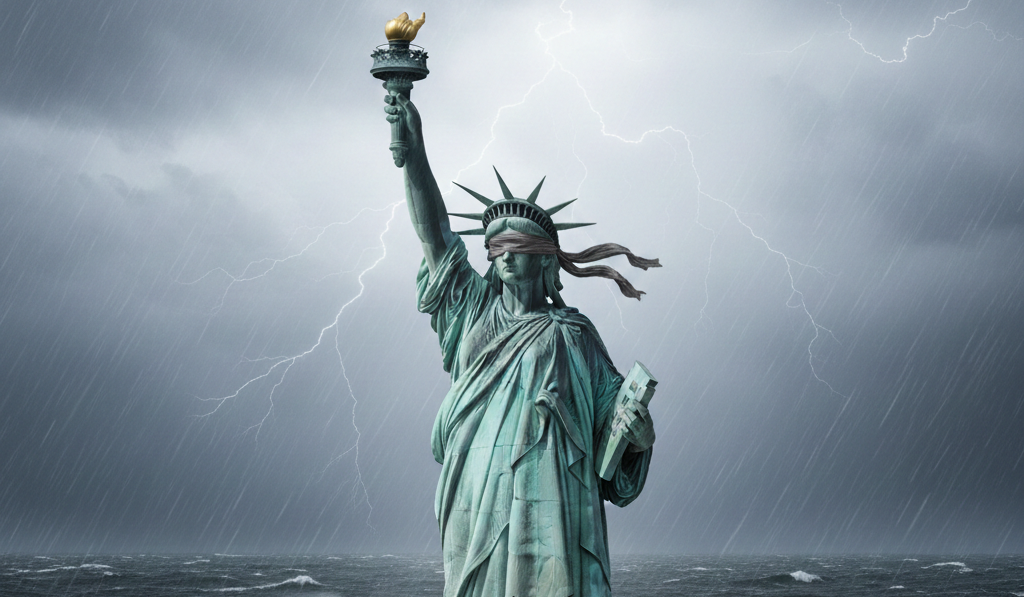
In April 2025, the U.S. Department of Justice issued internal guidance restricting official participation by its employees in events hosted by the American Bar Association. Under the policy, DOJ employees were prohibited from speaking at or attending ABA events in their official capacity, from using government funds to travel to such events, and from participating during official work hours. DOJ leadership stated that the restrictions were based on conflict-of-interest concerns, citing the fact that the ABA was engaged in litigation against the federal government.
In written communications and subsequent reporting, DOJ officials characterized the ABA as an "adversarial" organization. DOJ denied imposing a blanket gag order, stating that employees remained free to attend ABA events on their own time and at their own expense, provided they did not present themselves as acting on behalf of the Department.
In response to these actions and related funding decisions, the American Bar Association filed suit against the Executive Office of the President and multiple federal agencies. The ABA alleged that the government had engaged in retaliation and imposed unconstitutional conditions by withdrawing funding, access, and institutional participation in response to the ABA’s protected speech and litigation activity.
Separately, the Department of Justice moved to terminate federal grant funding previously awarded to the ABA. In mid-2025, a federal district court blocked the termination, finding that the ABA had demonstrated a likelihood of constitutional harm. Following the ruling, the DOJ withdrew its appeal, allowing the funding to remain in place pending further proceedings.
While the litigation proceeded, changes in professional participation became visible. DOJ officials were removed from or withdrew from scheduled ABA conference panels. Some panels were canceled or reformatted. DOJ components implemented additional review and approval requirements for public remarks by their employees at conferences and professional events.
During the same period, the legal industry experienced a marked increase in large law-firm mergers, including a series of transatlantic combinations between U.S. and U.K. firms. These included the merger of Allen & Overy with Shearman & Sterling, and the merger of Herbert Smith Freehills with Kramer Levin Naftalis & Frankel. Industry data showed that the number and scale of such cross-border mergers exceeded levels seen in prior decades.
Law firms involved in these transactions publicly cited international expansion, client demand, and competitive positioning as reasons for the mergers. No firm publicly attributed its decision to government speech policy or litigation involving the ABA. The mergers were announced, approved, and implemented while the ABA litigation and DOJ participation restrictions remained unresolved.
As of early 2026, the ABA’s lawsuits remained pending. No court had issued a final ruling on the merits of the retaliation or unconstitutional-conditions claims. DOJ participation restrictions remained in effect. Law-firm consolidation activity continued. These developments form the factual record on which the remainder of this analysis is based.
From Neutral Forum to “Adversarial” Actor
For decades, professional legal associations served as shared spaces where judges, prosecutors, defense lawyers, academics, and private practitioners could exchange ideas. Participation signaled professional standing rather than political alignment. That assumption has weakened. When an association is labeled “adversarial,” participation itself becomes fraught. Travel budgets are frozen. Panels are canceled. Officials are told to disengage.
The practical impact is immediate. Government lawyers decline invitations. Private practitioners reconsider visibility. The association remains lawful and active, but its gravitational pull weakens. Crucially, no speech is formally banned. Instead, access to institutional platforms is narrowed, and the cost of participation rises. The effect is subtle but powerful: fewer conversations happen in public view.
The Legal Theory: Retaliation Without Prohibition
Constitutional law has long recognized that government may not punish protected speech indirectly by withdrawing benefits. This principle—often called the doctrine of unconstitutional conditions—becomes central when funding, access, or professional participation is conditioned on alignment. The question is not whether lawyers may speak, but whether the state may impose penalties that predictably deter speech.
Legal challenges filed by professional associations argue that selective withdrawal of benefits constitutes retaliation when it tracks disagreement rather than neutral criteria. These suits do not allege that speech is illegal; they allege that institutional power is being used to reshape the field of permissible engagement. Courts tend to scrutinize such claims closely, particularly where long-standing practices change abruptly and selectively.
The Market Responds Where Courts Have Not Yet Ruled
Litigation moves slowly. Markets do not. While cases wind through procedural stages, law firms have responded through restructuring. The past two years have seen a surge in mergers—especially transatlantic combinations between U.S. and U.K. firms—that go beyond client convenience. Historically, firms handled cross-border work through alliances. Full mergers signal something else: diversification of regulatory and political risk.
By operating across jurisdictions with different professional norms and regulatory cultures, firms reduce dependence on any single regime. Governance becomes distributed. Revenue streams diversify. Partners gain optionality about where work is routed and where leadership sits. None of this requires a public statement about speech. It is adaptation by design.
Why the U.K. Matters
The United Kingdom offers a distinct professional culture. While no system is immune to pressure, the relationship between the state and legal associations differs. Traditions of professional independence, separate regulatory bodies, and a bifurcated bar provide alternative baselines. For U.S. firms, merging with U.K. counterparts is not merely geographic expansion; it is exposure to a second set of norms.
This matters in periods of uncertainty. When participation in domestic professional forums becomes politicized, firms seek structures that preserve room to maneuver. Cross-border governance can act as a buffer, allowing institutions to continue operating even as one jurisdiction tightens controls.
Inside Government: The Quiet Narrowing of Official Speech
Government lawyers occupy a unique position. They retain the rights of citizens while speaking on behalf of the state. Agencies have long regulated official speech, but recent changes emphasize centralized review and approval even for technical or educational remarks. Officials describe a shift from encouragement to caution.
The result is self-selection. Panels go unfilled. Explanatory talks are replaced by written guidance. Expertise remains, but it circulates internally rather than publicly. Again, the mechanism is not a gag order. It is risk management.
What Changes—and What Does Not
- Speech is not criminalized; platforms are constrained.
- Participation is permitted off-duty; institutional backing is withdrawn.
- Policies are framed as neutral; effects are selective.
The Chilling Effect, Measured in Behavior
Chilling effects are notoriously difficult to prove because they manifest as absences. The lawyer who declines a panel does not issue a press release. The firm that merges for risk diversification cites client service. The association that loses speakers quietly shrinks its agenda. Yet when viewed together, these absences form a pattern.
Behavioral evidence is often the earliest indicator of institutional stress. Before courts rule, professionals adjust. Before statutes change, markets adapt. In this sense, mergers and disengagement are data.
Is This “Censorship”? A Careful Frame
Words matter. Calling every constraint “censorship” obscures important distinctions and weakens credibility. What is emerging here is better described as governance through leverage. The state retains broad authority over funding, access, and official participation. When those levers are used selectively, speech may remain legal while becoming costly.
This distinction is essential for responsible reporting. The danger is not a formal ban; it is normalization of pressure as a management tool. Democracies have long grappled with where management ends and coercion begins.
The Institutional Lawsuit as Test Case
Professional associations have turned to the courts to draw that line. By bringing institutional claims—rather than individual grievances—they aim to test whether selective withdrawal of benefits crosses constitutional boundaries. These cases matter beyond the plaintiffs. They set parameters for how far executive authority may go in reshaping the professional ecosystem.
The outcome will influence whether other institutions step forward or continue to adapt quietly. A clear ruling could stabilize expectations. An ambiguous one may accelerate market-based responses.
Weaponization, Records, and Institutional Silence
Separate but contemporaneous litigation has raised additional questions about how governmental pressure can operate through control of information rather than direct restriction of speech. In 2025–2026, watchdog organization American Oversight pursued Freedom of Information Act litigation against the Department of Justice seeking records related to senior DOJ official Edward “Ed” Martin and the department’s newly created Weaponization Working Group. The lawsuit alleges prolonged delays in record production, failures to grant expedited processing, and inadequate searches amid concerns about the use of personal devices and auto-deleting messaging applications for official business. The National Archives and Records Administration opened an inquiry into potential federal records violations. These matters remain unresolved.
While the allegations have not been adjudicated, the litigation highlights a distinct mechanism by which institutional pressure may be exerted: opacity. When records are delayed, withheld, or potentially lost, external oversight becomes more difficult, public understanding narrows, and accountability is deferred. As with participation restrictions and funding disputes, no formal prohibition on speech is required for institutional effects to follow. Control over records can function as a parallel constraint, shaping what is visible, contestable, and ultimately remembered.
Key Takeaways
- Pressure without prohibition: Speech remains lawful while participation becomes constrained.
- Litigation vs. markets: Courts test boundaries; firms adapt in real time.
- Structural signals: Mergers and disengagement reveal stress before rulings do.
- Precision matters: Accurate framing strengthens accountability.
Conclusion: Watching the Quiet Frontiers
The legal profession is not monolithic, and its responses are not uniform. Some institutions litigate. Some firms consolidate. Some lawyers retreat from public platforms. None of this proves intent or outcome on its own. Together, however, these responses suggest a profession recalibrating under pressure.
Whether this moment marks a temporary adjustment or a lasting shift depends on decisions yet to be made—by courts, by agencies, and by professionals themselves. What is clear is that the frontier of free expression is no longer only about what may be said. It is increasingly about where, how, and with whose backing. That frontier deserves sustained attention.