The Department of Government Efficiency (DOGE), led by Elon Musk under the Trump administration, was sold to the public as a revolutionary program to slash wasteful bureaucracy and save trillions. Instead, it quickly became entangled in unauthorized data agreements, potential privacy violations, and Hatch Act violations — that appeared far more partisan than efficiency-driven. In practice it operated with almost zero meaningful oversight, zero public transparency about key personnel, and zero real accountability even when federal laws were broken.
At the Social Security Administration alone, DOGE staff signed unauthorized voter-data agreements with election-denial groups, routed sensitive personal information through unsecured third-party servers, and triggered Hatch Act referrals — actions that are not mere bureaucratic slip-ups but potential criminal violations of federal ethics, privacy, and data-security statutes. Yet no one has been charged, no senior official has been removed, and no independent inspector-general-style investigation has been allowed to proceed.
The lack of accountability was glaring from the start. When journalists and members of Congress repeatedly asked for the names of people actually serving on DOGE subcommittees or working groups — especially those with access to sensitive federal databases — the administration refused to disclose them. In several public documents and hearing transcripts, those names were either redacted or simply deleted after initially appearing. This is not normal government practice; it is the deliberate creation of a black box inside the executive branch.
Zero Teeth, Zero Consequences — Key Markers
- No public roster — DOGE subcommittee members' names were scrubbed from multiple documents after being requested
- No independent oversight — No special counsel, no binding IG investigation, no congressional subpoena power granted
- Hatch Act referrals ignored — Two SSA DOGE staffers referred in Dec 2025; no visible follow-up or discipline
- Data-security violations — Sensitive PII moved to unauthorized Cloudflare servers with no reported penalties
- Partisan mission creep — Official efficiency body used to pursue voter-roll challenges for election-overturn groups
This pattern — serious legal violations followed by stonewalling, name-redaction, and zero visible consequences — is not efficiency reform. It is the architecture of impunity.
The Government Admits It — And Congress Acts
For months, the violations described above were characterized by the administration as allegations, misunderstandings, or partisan attacks. That framing collapsed in early 2026. In a filing in AFSCME's lawsuit against DOGE, the Department of Justice acknowledged that DOGE employees had unlawfully accessed and misused Americans' Social Security data. The government's own lawyers — not outside critics, not advocacy groups — conceded the violation in a court filing.
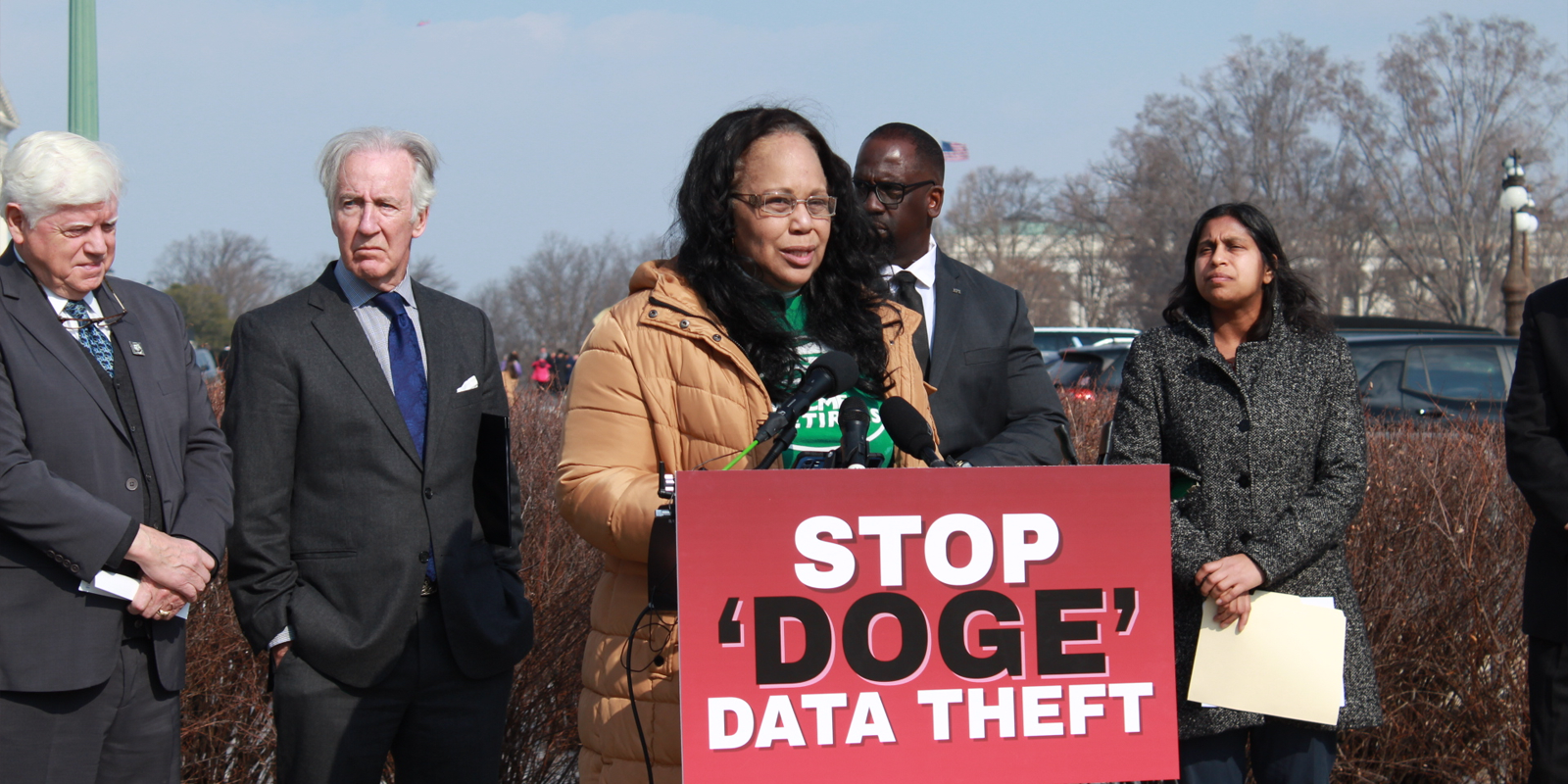
That admission triggered formal congressional response. Representatives John Larson, Richard Neal (ranking member of the House Ways and Means Committee), and Joe Morelle (ranking member of the House Administration Committee) announced a Resolution of Inquiry — a formal legislative mechanism to compel the Trump administration to hand over all records relating to DOGE's efforts to obtain SSA data. Every Democrat on the House Ways and Means Committee co-sponsored it.
The human dimension is equally important. Diana Lyles, an AFSCME retiree from Maryland and member of Maryland AFSCME Retirees Chapter 1, joined lawmakers on Capitol Hill to put a face on the data. She spoke on behalf of 2,500 AFSCME retirees who have formally called for investigation. "Seniors and people with disabilities have enough to worry about," Lyles said. "We shouldn't also have to worry about our Social Security data being misused or put at risk by billionaires who will never have to rely on a Social Security check."
Where Accountability Now Stands
- DOJ admitted DOGE employees unlawfully accessed and misused SSA data (court filing, early 2026)
- Resolution of Inquiry filed — bipartisan mechanism to compel administration records disclosure
- AFSCME lawsuit active — unions and retirees seeking emergency relief to block ongoing data overreach
- 2,500 retirees on record demanding investigation and accountability
- Congressional co-sponsorship — every Ways and Means Democrat signed on
What was alleged is now partially admitted. What was stonewalled is now subject to formal compulsion. The question is no longer whether violations occurred — the government has conceded that. The question is whether the accountability machinery can function when the executive branch controls both the conduct and the investigation of that conduct.
The DOGE-SSA Scandal Unveiled
In March 2025, two DOGE team members were contacted by a political advocacy group — widely believed to be True the Vote — seeking analysis of state voter rolls to uncover alleged fraud and overturn 2024 election results. One signed the agreement without agency approval, potentially involving SSA data matching. No confirmed data sharing has emerged, but emails hint at requests for access.
This revelation came in a January 16, 2026, court filing (Case 1:25-cv-00596-ELH), where the Justice Department admitted DOGE's use of unsecured servers like Cloudflare to share sensitive PII of over 1,000 individuals, violating agency policies.
Key Risks Exposed
- Data Privacy Breaches: DOGE's use of unsecured servers risked exposing millions' Social Security info.
- Partisan Misuse: Ties to election denial groups undermine neutral governance.
- Workforce Gutted: 300K+ federal employees — roughly 12% of the entire civilian workforce — removed under DOGE, stripping the institutional knowledge that would have caught or resisted these violations.
Access Was the Asset: From SSA to the Pentagon
The SSA data scandal cannot be understood in isolation. It is one chapter in a longer story about what DOGE's true purpose was — not cutting waste, but acquiring access. While embedded across federal agencies, DOGE teams gained unprecedented visibility into Defense Department data, processes, and decision-makers. Musk departed DOGE in late May 2025. Within months, his company xAI emerged as the Pentagon's AI partner of choice.
In July 2025, the Defense Department awarded xAI a $200 million contract to integrate Grok — Musk's AI system — across Pentagon networks, eventually giving 3 million military and civilian personnel access. According to a former Pentagon contracting official, the contract "came out of nowhere" when other companies had been under consideration for months. Industry analysts noted xAI "did not have the kind of reputation or track record that typically leads to lucrative government contracts."
What xAI did have: Musk's DOGE-era access to Defense Department systems and the relationships built during that tenure. The SSA data violations and the Pentagon AI deployment share the same logic. In both cases, DOGE wasn't solving a problem — it was opening a door. And the door led directly to federal contracts for Musk's private companies.
The pentagrok deployment raised immediate alarm. Senator Elizabeth Warren formally questioned the contract award process, highlighting Musk's conflicts of interest. Cybersecurity experts warned Grok fails key federal AI risk frameworks. And Defense Secretary Pete Hegseth's framing — that the systems would "operate without ideological constraints" — translates directly to AI systems designed without anti-discrimination safeguards, the same framing used to justify automated targeting systems already deployed in active conflict zones.
The Consolidation: One Company, One Man, Everything
In February 2026, the architecture became explicit. SpaceX acquired xAI — which had previously absorbed X (formerly Twitter) — creating what is now the world's most valuable private company at approximately $1.25 trillion. Under one corporate roof: the dominant platform for real-time political speech, the AI system now embedded in the Pentagon, orbital infrastructure via Starlink, and rocket manufacturing with $15+ billion in federal contracts.
This is what the Class Action Lawsuit Framework — a comprehensive 117-page legal architecture drafted in December 2024 — identified as the core constitutional crisis: for the first time in American history, one individual simultaneously controls the dominant platform for real-time political discourse, exercises official government advisory power, and holds massive federal contract leverage. The framework argues this convergence creates state capture of communication infrastructure — the structural precondition for authoritarianism that the First Amendment was designed to prevent.
The lawsuit's central legal insight is what distinguishes this from previous platform accountability cases. In Murthy v. Missouri, the Supreme Court dismissed government platform pressure claims because plaintiffs couldn't prove causation — couldn't show which government communication caused which platform decision. Here, there is no separation to analyze. Musk IS government AND platform. Causation is automatic. Every moderation decision made during his government tenure is by definition state action subject to First Amendment scrutiny.
The Consolidation Timeline
- Jan 2025: DOGE established — Musk embeds teams across all federal agencies
- Mar 2025: Unauthorized SSA voter data agreement signed without agency approval
- May 2025: Musk departs DOGE with unprecedented DoD data access
- Jul 2025: xAI awarded $200M Pentagon contract — "came out of nowhere"
- Dec 2025: EU fines X €120M for deceptive practices; DOJ admits DOGE unlawfully accessed SSA data
- Feb 2026: SpaceX acquires xAI (which houses X) — combined entity valued at $1.25 trillion
- Mar 20, 2026: Federal jury finds Musk liable for defrauding Twitter shareholders — damages up to $2.6B
The Verdict: Fraud, Finally on the Record
On March 20, 2026 — yesterday — a federal jury in San Francisco delivered a verdict that cuts through the Teflon. In Pampena v. Musk, a civil class action filed by Twitter shareholders in October 2022, the nine-person jury found Musk liable for deliberately driving down Twitter's stock price with false statements in the months leading up to his $44 billion acquisition. Specifically, the jury found two tweets — including one claiming the deal was "temporarily on hold" — contained false statements that caused investors who sold their shares to suffer real losses. Damages are estimated at $2.1–2.6 billion.
This isn't a peripheral story to the DOGE scandal. It is the same story. Musk acquired Twitter through conduct a jury has now found to be fraudulent. He renamed it X. He merged it with xAI — using that combined entity's AI system to land a $200 million Pentagon contract built on DOGE access he gained while simultaneously overseeing the unlawful handling of Americans' most sensitive government data. SpaceX then absorbed the entire structure. The company that sits at the center of a $1.25 trillion empire was purchased through conduct that, as of yesterday, a jury has concluded misled investors.
Musk's attorney is expected to appeal. And even a $2.6 billion award — the outer estimate — amounts to less than 0.4% of his current net worth of approximately $661 billion. As one plaintiff's attorney put it: "Musk's status as the world's richest man is not a free pass." But the financial math of American justice suggests it might function as one regardless. The structural remedy — forcing separation of government power from platform control — remains unavailable in a securities fraud case. That's what the class action framework exists to pursue.
There is also a separate active SEC lawsuit alleging Musk failed to properly disclose his initial Twitter stock purchases in early 2022 — an undisclosed accumulation that allegedly cost other shareholders at least $150 million. That case is reportedly in settlement talks.
The Fracture: Epstein, Accusations, and the Impunity Baseline
The relationship between Musk and Trump, once publicly close, soured dramatically in mid-2025. After Musk left DOGE amid disputes over budget impact and actual savings, the feud escalated into public accusations. Musk posted on X:
— Elon Musk, June 2025
Trump responded by downplaying DOGE's results, claiming promised savings were "very minimal." Musk countered by positioning himself as a crusader for Epstein file transparency while preemptively defending his own record:
— Elon Musk, 2026 X Post
What began as a high-profile partnership between two of the most powerful figures in America ended in mutual finger-pointing — with the Epstein files weaponized as a rhetorical club. The more important signal is structural: the fracture itself produced zero accountability for either party. No charges, no investigations, no consequences. The impunity is not a bug in the relationship between these two men — it is the foundation of it. When the alliance serves both parties, violations are covered. When it fractures, accusations fly — and still nothing happens. That is the baseline the DOGE violations exist within.
Intersections: Institutional Capture and the Kleptocratic Pattern
The DOGE-SSA scandal doesn't exist in isolation. It is one thread in a larger pattern that critics describe as modern kleptocracy: foreign policy leveraged for business interests, enforcement agencies converted into data pipelines, elite venues used for deal-making, and efficiency rhetoric deployed to dismantle the oversight structures that would normally catch or prevent all of the above.
DOGE removed approximately 300,000 federal employees — roughly 12% of the entire civilian workforce. These weren't just numbers. They were experienced civil servants who understood procurement processes, oversight requirements, and how to push back on questionable directives. Their removal created the institutional vacuum that made the SSA data violations possible and the Pentagon AI contract award question marks invisible. Government spending, meanwhile, increased by 6% during DOGE's tenure. The national debt grew by more than $2.2 trillion. Even Musk later acknowledged DOGE was only "somewhat successful."
Media capture amplifies the accountability gap. The Washington Post's editorial direction shifted under Bezos ownership as Amazon's government contracts expanded — a pattern the inverted totalitarianism framework describes as corporate power subordinating democratic forms rather than overtly replacing them. The captured institution doesn't announce its capture. It simply stops asking the questions it used to ask.
What This Means for Accountability
- Whistleblower Protections: Essential — the SSA's former chief data officer's complaint was the first public signal of what court filings later confirmed.
- Structural Remedy: Monetary damages alone cannot fix the architecture. The class action framework's demand — divestiture or resignation — is the only remedy proportionate to the structure of the problem.
- Congressional Compulsion: The Resolution of Inquiry is the right mechanism but requires follow-through. Compulsion only works if the compelled party faces real consequences for non-compliance.
- International Pressure: The EU's €120M fine on X for deceptive practices shows external accountability can move where domestic accountability stalls.
Conclusion: Accountability Begins — While the Architecture Remains
The question this article once asked — when will visibility lead to action? — now has a partial answer. The DOJ has admitted the violations. Congress has formally moved to compel records. A jury has found fraud in the acquisition at the center of the empire. AFSCME and its union allies remain in active litigation. The EU has imposed documented penalties.
But the architecture remains intact. One man still controls the platform where political dissent organizes, the AI system inside the Pentagon, the rocket company with $15+ billion in federal contracts, and the government relationships that made all of it possible. The consolidation completed in February 2026 means that accountability against any one piece — a fraud verdict here, a Resolution of Inquiry there — operates against a structure that has already absorbed and moved past each individual challenge.
That is the definition of systemic impunity: not the absence of accountability, but accountability that arrives too slowly, too narrowly, and too cheaply to alter the underlying structure. The class action framework puts it plainly: you can be a billionaire platform owner, or you can be a government official, but you cannot be both. Until that principle is enforced — through divestiture, resignation, or structural judicial remedy — the violations documented here are not anomalies. They are the operating model.
Refusing to normalize this, through persistent scrutiny and documented resistance, remains the first step. The wartime series continues.